Monday, February 17, 2020

RECYCLING 3500 YEARS AGO

17 February 2020: These days, much of the "let's fix the world" talk/advice/"wisdom" deals with recycling and re-purposing. Surely, it's a great idea and one worth following when possible. The younger generation acts as if they discovered/invented it and yet, here is evidence that the ancient Egyptians were re-purposing and recycling routinely 3500 years ago. The following is from ABC News recently.
                                             ~~~~~~~~~~~


Man finds 3,400-year-old Egyptian anchor during his morning swim

Rafi Bahalul found the artifact off the coast of Israel. 

Rafi Bahalul was taking a morning swim off the shores of Atlit, Israel, when he spotted hieroglyphs in the seabed.

"I saw it, kept on swimming for a few meters, then realized what I had seen and dived down to touch it," Bahalul told Haaretz. "It was like entering an Egyptian temple at the bottom of the Mediterranean."

 Bahalul had discovered a 3,400-year-old Egyptian stone anchor, confirmed by Jacob Sharvit, head of the Israel Antiquities Authority's maritime archaeology unit.

The anchor is currently on loan from the Israel Antiquities Authority to the Israel Museum in Jerusalem and is on display as part of its Emoglyphs: Picture-Writing from Hieroglyphs to the Emoji exhibition. 

Emoglyphs is the study of the transformation of picture writing from Egyptian hieroglyphs, developed some 5,000 years ago, to the 'emojis' of the 21st Century.

Shirly Ben Dor Evian, curator of Emoglyphs, said the stone would have initially been part of a larger, ornate wall relief. Repurposed as an anchor, it was cut from the relief and drilled with a hole to attach a rope. 


"The stone was discovered by chance -- spotted on the seabed by a swimmer," Ben Dor Evian told ABC News and said the relic is still being researched. "The Egyptian relief was reused as a stone anchor on a ship sailing the Mediterranean coast," she said.

Addressing the mystery of how the Egyptian relic was found off the coast of Israel, Ben Dor Evian proposed that it was separated from an Egyptian ship sailing the Mediterranean coast, perhaps lost in a shipwreck.

"The ship crew must have lost the anchor or the ship was shipwrecked," she said, adding that whether or not the anchor can contribute to a new understanding of ancient Egyptian life is "still under research."

The site where Bahalul made the chance discovery, just south of Haifa, was already known to archaeologists, according to the Jerusalem Post. 

Depicted on the stone are the hands of Seshat, the Goddess of Writing, Ben Dor Evian said. An accompanying inscription reads, "mistress of the house of books."
                                             ~~~~~~~~~~~~~~~~~~~~~~~~~~~~~~~~~

I hope you didn't expect to see a picture of a traditional "old fashioned" anchor;
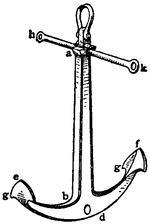
Image result for origin of old fashioned anchor the ancients clearly had not yet got there, but a large rock wrapped in rope or, as in this case, a piece of stone originally used for something else would answer nicely as long as it was heavy enough. The "traditional" anchors evolved over thousands of years, going through wood (yes wood,though it was weighted with stone and later, lead) eventually to iron and then, around the 15th or 16th century, to the form we think of as an "old fashioned" anchor. Interestingly, anchors were relatively light because the windlass/winch had yet to come along and to augment the lightness, ships used as many as eight or ten anchors, depending on the conditions. Modern anchors i.e Danforth, CQR, plows etc did not come along until the 20th century.

Until next time, 
                                Fair Winds,
                                     Old Salt


Sunday, February 9, 2020

WRECK OF GOLDEN RAY TO BE CUT UP

9 February 2020: Back in September 2019, a 656' car carrier named Golden Ray  headed out to sea from the Port of Brunswick with a cargo of 4,200 Kias and Hyundais. The 25,000-ton ship was executing a right turn around 1:30 a.m. through the St. Simons Sound when the ship’s hull began listing heavily.
The Golden Ray then rolled over onto its port side, running aground in the ocean bed of the St. Simons Sound just south of the federal shipping channel that serves the port. Those in the know said this final resting place for the Golden Ray was no accident. They credit veteran Port of Brunswick Harbor Pilot Jonathan “T.J.” Tennant with intentionally guiding the ship toward a grounding outside of the port’s vital shipping lane.
While certainly a tourist attraction, she is also an obvious hazard to navigation and has to be removed. The question is how. CNN offers the following piece on that question and it's really quite amazing. 
           ~~~~~~~~~~~~~~~~~~~~~~~~~~~~~~

Golden Ray before....

If you live in Georgia near the Golden Ray, a 656-foot long cargo ship that has been on its side in St. Simons Sound for five months, get ready for some noise.

Apparently, a good bit of noise.

"There's no way to remove the Golden Ray without making noise -- there's no way around it," said Kevin Perry of Gallagher Marine Systems. "... We appreciate everyone's patience with the noise levels as we work to remove this wreck as quickly and safely as possible."

At a news conference Friday (7 Feb), he said the sounds will be like hammering you might hear from a construction site.

Officials hope to have the removal of the car carrier completed by the height of the Atlantic basin hurricane season, which begins June 1. The Golden Ray capsized September 8, and has been on its side and half submerged since.

The work to put up an environmental barrier will start the middle of this month and will only take place during the daylight, officials said. The final product will include a large floating boom to skim pollutants from the surface and netting to stop debris.

But then the ship, which still has more than 4,000 cars on it [now there's a deal for someone!- ed], will be cut into eight giant pieces with a giant diamond-cutting chain suspended from a lift vessel, officials said.


Once the sawing starts, it won't stop, and they think it will take 24 hours for each cut.

"That means noise through the night during some ... periods," said John Maddox, Georgia Department of Natural Resources on-scene coordinator.


The VB-10,000 vessel will be an interesting addition to the view from shore.

It comprises two metal towers, about 240 feet tall, each connected to a barge and to each other at the top. A crane will remove the sections after they have brackets attached to the side, the vessel will move, and the crane will put each section on a barge, which will take them to a recycling facility.

 Here's what the process looks like (animation): Click here

The sections will be wrapped to contain debris, T&T Salvage said in a presentation. Anything that falls to the sea floor will be picked up with magnets or grabs.
                              ~~~~~~~~~~~~~~~~~

How's that for ingenuity! We will more than likely find more on this amazing recovery operation as the winter gives way to spring and will be sure to bring it to you.

Until next time, 
                                              Fair Winds, 
                                                    Old Salt

Saturday, February 1, 2020

BERMUDA TRIANGLE GIVES UP A SECRET

1 February 2020: Once (and maybe still), the Bermuda Triangle was the stuff of baffling and oft times scary stories of disasters; numerous ships, the famed training flight (from Jacksonville FL), to monsters and aliens, all disappearing for no reason and without a trace. All manner of explanations have been put forth, none proven conclusively - or for that matter, disproven conclusively. And now, from the British Mirror, a lost ship most likely "found:"
                                ~~~~~~~~~~~~~~~~~~
 

Ship that vanished 100 years ago in the Bermuda Triangle 'found off coast of Florida'
Researchers believe they have found the wreckage of the SS Cotopaxi, which vanished in the Bermuda Triangle in 1925 - and if they're correct it has been hiding in plain sight for years
The wreckage of a coal ship that disappeared in the Bermuda Triangle nearly 100 years ago while on its way to Cuba was hiding in plain sight, researchers say.
American merchant steamer the SS Cotopaxi has long been the subject of many conspiracy theories and hoaxes after seemingly vanishing without a trace during a "routine voyage" in 1925.

Cotopaxi in better days
The disappearance has helped fuel the legend of the Triangle, a notorious section of the western North Atlantic where numerous vessels and aircraft have seemingly vanished in bizarre fashion.
The fate of the Cotopaxi, which left Charleston, South Carolina, on November 29, 1925, heading for Havana, and the 32 people on board has baffled experts - but now it seems the answer has been there for years.
Marine biologist and underwater explorer Michael Barnette, speaking to Newsweek, said: "We know that on that voyage something happened because she delivered a mayday message early December saying she's in distress.
"And then that was it. They never found any wreckage. They never found any lifeboats, bodies or anything. The vessel just disappeared after that point. So we've been trying to determine what happened."

In the Gobi Deseret (not so much!)
The ship was famously 'discovered' in the Gobi Desert in classic 1977 Steven Spielberg movie Close Encounters of the Third Kind, having been supposedly placed there by aliens.


While reports in 2015 claimed it had reappeared near a restricted military zone off the coast of Cuba, though this was dismissed as a hoax.
But nearly a century on since its last confirmed sighting, Barnette and his team claim they located it 35 miles off the coast of St Augustine, on Florida's northeast coast.
And the supposed surprise discovery will feature in an episode of Shipwreck Secrets on the Science Channel in February.
Barnette is prolific in his discovery of lost ship wreckages and said while all history has always fascinated him, "maritime history is my real passion".
"I like going out and trying to identify wrecks because every one has a fascinating story. I'm just a very curious guy," he added.
While digging in the archives of Lloyd's of London, the explorer found documents proving the Cotopaxi sent out a distress signal on December 1, 1925, something historians had not known previously.
"A lot of times, it's more important to spend more time in the archives researching than it is on the water, because that's when you will make the discoveries in all these articles for insurance or things of that nature," Barnette said.
The signals were picked up in Jackonsville, Florida, meaning the ship must have sent them near the famous 'Bear Wreck' off the coast of St Augustine, a thriving port in colonial times - which is littered with shipwrecks.
But while most of these are from the 16th and 17th centuries, the Bear Wreck - whose real name and background are unknown - is likely from as recent as the early 20th century and is further off the coast.
Diver Al Perkins has been exploring that wreck for 30 years and collecting various objects as he goes - including a valve manufactured by a company based just a few miles from Ecorse, Michigan, where the Cotopaxi was built.
He gave the valve to Barnette during his investigation who then conducted more dives to collect measurements of the Bear Wreck to compare them to the original Cotopaxi plans.
He found they were a match before documents were found at the National Archives of New York in relation to a legal case families of the missing crew had brought against the ship's operator - the Clinchfield Navigation company, arguing the ship was unseaworthy.
As part of his testimony the company president specified the last known coordinates on November 30, 1925, which Barnette plotted putting the doomed vessel 22 miles north of the Bear Wreck on that last date.
The co-ordinates appeared to have the Cotopaxi on its expected course to Havana.
While according to weather records, a large storm struck the Florida coast on December 1, which could have sunk the vessel, which would explain the distress signal, if it had stayed on course from the previous day.
Barnette said: "We approach all these shipwrecks kind of like a cold case murder case, right? You know, you have the body there. You try and gain whatever information you can. There's a whole bunch of tools that we use to try to identify these wrecks."
He described the realisation that the Bear Wreck was probably the Cotopaxi as like a "jolt of electricity."


"A lot of times it is very emotional because first you are excited that your theory is correct. There's also an emotional rollercoaster because you realize, 'wait a second, this is a grave site which marks the final resting spot spot of the crew members that went down with the vessel.' So there's a responsibility to try and reach out to the families so we can help give closure to them," he said.
"Myself and other wreck divers around the world, when we identify these wrecks, sometimes we're writing the final chapter in the story or sometimes we're actually rewriting history," he said. "What people assume actually happened sometimes is not the case."
He added: "Each one of these shipwreck stories is their own saga, and a lot of times you kind of hit on the Bermuda Triangle. But the Bermuda Triangle is not the story, it's the drama that unfolds on these individual shipwrecks, and aircraft."
                                     ~~~~~~~~~~~~~~~

So it's been there all the time! And investigated. Just that no one had identified it before. The same with so many things like this!

Until next time, 
                                     Fair winds, 
                                          Old Salt