
22 March2026: Here we are again; Mother Nature is proving her fickleness (is that a word?) by alternating hot (west coast) and cold (east coast), huge storms and sunny days, and keeping us all guessing... they tell us it will settle down and give the weather-guessers a fighting chance at getting it right!
In the interest of avoiding "wreck reporting" (we've been accused of that) and disaster stories, here's something about some new tech the Navy has developed which will possibly report actual weather (even though that's not the focus) -among other things. From Slashgear.com.
~~~~~~~~~~~~
The U.S. Navy is fully on board the autonomous surface vessel (ASV) wagon as it moves toward having half of its surface fleet be unmanned by 2045 [ed: certainly solves a recruitment issue!]. In 2025, it launched an autonomous 180-foot warship, known as the USX-1 Defiant. In February 2026, its new Lightfish drone hit the open ocean. The unmanned solar-powered Lightfish is built by Seasats, a private company based in San Diego, California.
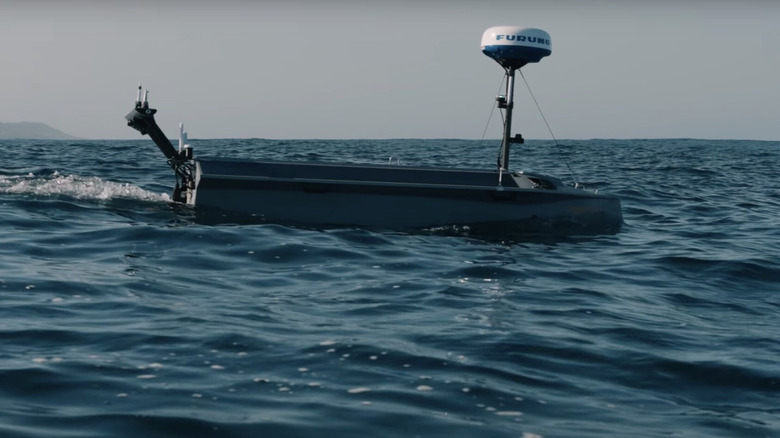 |
| Not a pretty vessel |
Seasat's Lightfish is a 305-pound drone designed for general-purpose activities such as surveying, research, and security patrols. With the U.S. Navy, it will be used in missions to constantly gather intelligence through surveillance and reconnaissance along shorelines, in harbors, and even in the open ocean. With a top speed of 5 knots (5.75 mph), [ed: makes it a perfect target, at that speed] it can conduct a wide range of maritime domain awareness missions, including port and coastal security, drug trafficking, illegal fishing, and other threats.
The Lightfish, which measures just 11.4 feet x 3.4 feet, can survive up to six months or 8,000 nautical miles at sea without human intervention. It has a payload of 66 pounds and can be deployed at a moment's notice by one or two people. Additionally, it can be easily hauled in the back of a truck or placed aboard almost any aircraft. The Lightfish joins other sea-faring drones, including an unmanned underwater drone that the German Navy tested in 2025
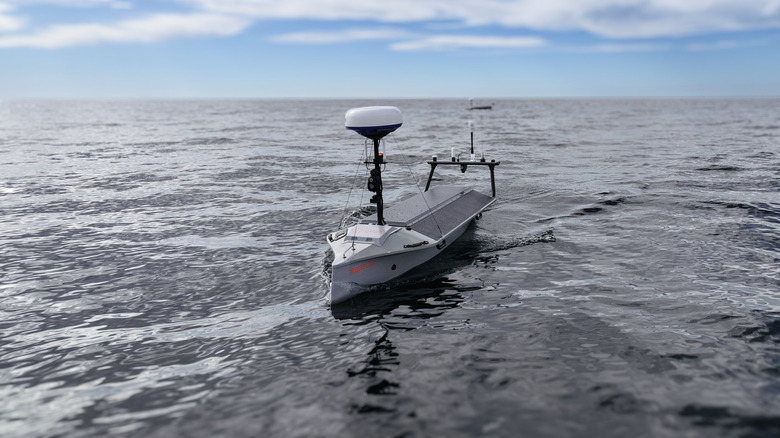 |
| a more flattering view |
Lightfish is equipped with a bevy of high-tech equipment (including collision avoidance, onboard Artificial Intelligence, and GPS-denied navigation), five high-definition cameras, and redundant communication systems including LTE, Iridium SBD, Iridium Certus, and Starlink.[ed: probably no problem in connecting to the internet - unlike ashore!] The drone's solar-electric power system has a supplemental built-in methanol fuel cell that can supply 11 or 28kWh of power. The ASV has an Electric Drive Torqeedo 1103 with a weedless propeller equal to a 3-hp outboard motor. Additionally, its weighted keel allows it to right itself in conditions up to Sea State 6, where waves can reach heights of 20 feet.
Lightfish is meant strictly for surveillance and recon, unlike other privately-built USVs like the Cardona Marine Group, Inc.'s Sea-Predator-7, which is equipped with an array of munitions to deal lethal damage. The drone has a modular construction for easier maintenance and better customization, and most payloads can be swapped in minutes. With such a technologically advanced unit, one might think it would take a specialist to operate it. Not so. Seasats claims that its browser-based controls allow anyone to learn to navigate this ASV within five days.
Seasats' other two ASVs are the Quickfish and Heavyfish. The former has a top speed over 35 knots (40.28 mph), making it ideal for fast-response tactical operations. But it can only last a month without intervention, and its 1,450-pound weight (and 450-pound payload) requires a trailer to move and launch. Heavyfish weighs 9,000 pounds (with a 1,000-pound payload) and requires an even larger vehicle to move and a crane to get into the water. It too can last six months at sea, and has a top speed of 12 knots (13.81 mph).
In June 2024, a Lightfish drone traveled some 2,500 miles from San Diego to Joint Base Pearl Harbor Hickam in Hawaii. The 73-day trip was so successful that the team decided to send it on to Japan, but it was put out of commission by a typhoon [ed:oops] along the way when water got into the hull.
Lightfish performed the same run a second time to prove itself, again starting at the company's headquarters in San Diego. After a stopover in Hawaii for a demonstration, it continued past Wake Island and Guam, and took part in another demo in Okinawa. It finally arrived in Japan on July 30, 2025, with the successful trans-Pacific trip covering 7,500 miles in 150 days.
In early February 2026, the U.S. Sixth Fleet — specifically, Commander Task Force (CTF) 66 — successfully tested Lightfish during Exercise Cutlass Express 2026 in the Western Indian Ocean. It was launched from the Seychelles Navy's SCG auxiliary Saya De Malha (A605). Combined with upcoming drones like Lockheed Martin's Lamprey multi-mission autonomous undersea vehicle, the Lightfish could make the seas much safer for the U.S. and its allies.
~~~~~~~~~~~
So, unmanned in '45! There's worthy goal (and slogan)! While I won't be around to collect, I would be wiling to wager a fair amount it won't happen!
By the way, further to a previous post on the America's Cup debacle, there's more news on that front: conflict in England. Apparently INEOS (the company who has sponsored the British entries, wants their boat back, and Sir Ben Ainlsey doesn't want to give it up as the campaign will be using the same boats again next year that they used in the last competition. So... we'll see how that plays out!
Until next time, stay safe!
Fair Winds,
Old Salt

No comments:
Post a Comment