Sunday, December 4, 2016

ARCTIC CRUISE - BRRRR

4 December 2016: Now that we're into December and the weather has begun to turn cool ... some days actually cold - I thought a post about a little ride through the Northwest Passage might be interesting. As if we're not cold enough already. But consider this, from Yachting World Magazine....
British sailor/adventurer, David Cowper, who already holds several world records decided to take on the quest for the Northwest Passage. Here's his story:


British sailor and explorer David Cowper has successfully transited one of the most difficult routes of the North West Passage, the Hecla and Fury Straits. On 27 August, accompanied by his son, Fred, Cowper became the first to navigate through this passage since William Parry discovered it in 1822 with the ships HMS Hecla and HMS Fury.
He departed from Maryport in Cumbria at the end of July in his strengthened and specially designed 48ft aluminium motorboat Polar Bound, navigating singlehanded to Greenland.

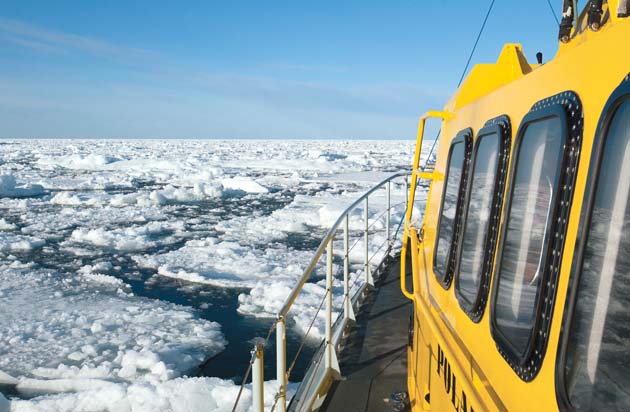
Then, joined by his son, he continued beyond the Arctic Circle, and south of Baffin and Victoria Islands on a route considered by some to be the world’s most difficult.


Conditions were ferocious at times, with strong tidal rips, seas of 7m and more and winds gusting over 60 knots. In Hudson Strait they encountered several miles of ‘swirlers’, which he noted was ‘like being in an 18ft sea that couldn’t find its way out of a washing machine; we were trapped in the cabin being washed around with green water flying over Polar Bound.’
The boat was nearly pitchpoled and father and son were bruised from being thrown around. They lay ahull for several hours until the tide turned. David Cowper noted: ‘conditions were atrocious’.
Polar Bound was designed by Dennis Davidson of Murray Cormack Associates and built by New Century Marine in one of the former minesweeper sheds at the old McGruers yard in Rosneath that Cowper owns. She is shaped like an egg – Cowper would rather describe her as ‘spoon-shaped’ – albeit an egg designed not to crack even under the pressure of 65 tonnes of ice.


Prior to this summer’s Hecla and Fury voyage, Polar Bound underwent a two-year refit, having successfully returned from the Arctic after Cowper’s fifth – and most audacious – transit of the North West Passage, via the McClure Strait, the most northerly of the seven routes, one of a number of ‘firsts’ achieved by this most modest of seafarers.

Polar Bound’s refit has been forensic. Cowper leads me down the double-dogged forehatch in the forepeak, where shelves of plastic boxes contain everything he will need on a voyage he says will last one, maybe two – who knows – three years? A vicious-looking old wooden-handled RNLI boathook rests against the hull, a relic from the Watson, used for cutting weed off clogged propellers.
Watertight bulkheads separate this from the engine room and bow compartment. The space is immensely strong. This is the second line of defence, the first being a stem, already super-strong, further protected by a sharp, hefty strip of aluminium.

Every seacock and valve is accessible; every one has been dismantled and greased. Cowper has a tool for everything. A Dickinson Bering stove in the saloon, insulated with one tonne of rock wool, has been nickel-plated. “I hate rust,” he says with a passion you might express about mice in the rafters.

That's it for now; I'm still shivering! 

                              Fair Winds,
                                      Old Salt


Tuesday, November 29, 2016

RESTORED PT BOAT RETURNS HOME

29 November 2016: We had some issues with the earlier posting of this story and are trying again!

Courtesy of FoxNews:


A historic World War II boat that survived dozens of operations -- and a few near-misses -- on the other side of the Atlantic is finally heading home to the waters where its journey began more than 70 years ago.
PT-305, fresh off a multi-year restoration project at the National World War II Museum in New Orleans, is traveling atop a barge set to reach the Industrial Canal near Louisiana’s Lake Pontchartrain by midday Tuesday.


“This is a big deal for all of us, but especially for the men and women for the last ten years who put blood, sweat and tears into the restorations,” Stephen Watson, museum executive vice president and COO, told FoxNews.com Monday.
The battle-hardened boat, nicknamed the U.S.S. Sudden Jerk, operated in the Mediterranean along the coasts of southern France and Northern Italy. PT-305 conducted more than 77 offensive patrols and operations, fought in 11 separate actions and sank three German ships during its 14-month deployment, according to the museum.
Following WWII, PT-305 took on a civilian role as a tour boat in New York Harbor, a fishing charter and an oyster boat, while falling into disrepair before the New Orleans museum scooped it up in 2007.
From there, a volunteer crew worked more than 100,000 hours on the project at the museum’s restoration pavilion to get PT-305 running again.


On Friday afternoon, the boat was moved outside the facility where volunteers, according to Watson, gathered for some quiet time before traffic lights and public signage was removed to make way for its 1-mile trek to the Mississippi River.
The next day, the boat, resting on a cradle, was lifted up onto a self-propelled modular transporter and was headed on its way.


“It was just a remarkable thing to see. They made it look so easy,” Watson said of the crew who walked alongside the vehicle and PT-305 as it slowly turned corners and moved through the streets.
Working in coordination with the Port of New Orleans, PT-305 arrived Saturday when no cruise ships were docked. It was hoisted onto a barge, which traveled down river, and is now heading back in the other direction through canals toward Lake Pontchartrain.

On a personal note, I saw this project a couple of years ago and was very impressed with the attention to detail and devotion the volunteers put into the project.... It is nice to hear it's finally back where it belongs!

Until next time,
                                            Fair Winds,

                                                             Old Salt