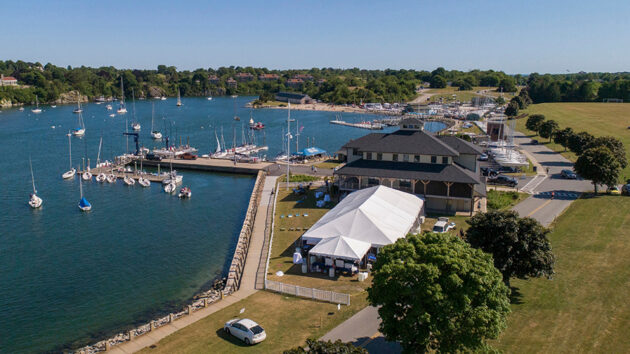
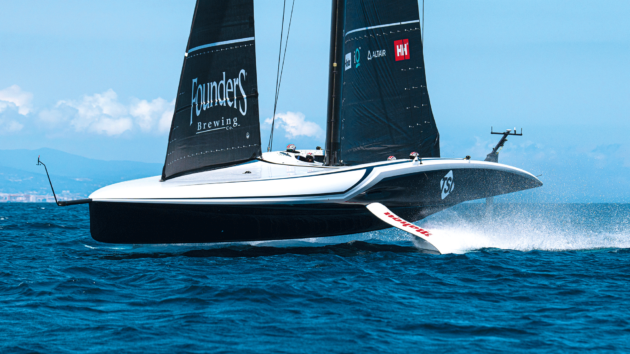
3 May 2026: our short-lived summer weather has gone, leaving chilly windy "spring" conditions in its wake. Boats that got uncovered, prepped, and splashed wait impatiently for crews to brave the less-than-comfortable conditions to take that first sail. Soon, my friends, soon (I hope).
One of the great unsolved mysteries of the maritime world is "what happened to the to Mary Celeste?" Everyone with even a sight connection to the sea and/or history has heard the story of the completely intact and totally unmanned brigantine sailing in the eastern Atlantic in the 19th century. No one has been able to determine the events which led to the crew abandoning the ship. Now, mystery unraveled. From ZMEScience.com
~~~~~~~~~~~~~
In December 1872, sailors spotted a ship drifting aimlessly in the open Atlantic, some 400 miles off the coast of the Azores.
The Mary Celeste, an American brigantine, rode the winter swells in eerie silence. Her sails were slightly tattered, but her wooden hull remained perfectly sound. Below deck, the cargo hold sat largely undisturbed, containing nearly all of its original freight. The uncrewed drifting ship was brought to Gibraltar by a British vessel.
Her captain, his family, and every single crew member had vanished. They left behind their possessions, their shelter, and a huge unsolved riddle that would puzzle the world for more than a century.
For generations, the phantom vessel birthed wild speculation. Storytellers blamed ruthless pirates, deep-sea monsters, sudden illness, mutiny, and even supernatural forces.
Now, scientists have firmly anchored the legend within the rigid laws of chemistry.
Researchers have demonstrated that a rapid, invisible explosion of alcohol vapour tore through the ship. The terrifying blast would have driven the panicked crew into the open ocean, leaving behind a pristine ship and a haunting legend.
***************
From The Brooklyn Daily Eagle 1902

Crew of the Mary Celeste · Sun, Mar 9, 1902 – Page 40 · The Brooklyn Daily Eagle (Brooklyn, New York)
But the Atlantic crossing proved brutal. Crew members battled rough weather and kept the hatches down tight to keep the crushing ocean out.
In doing so, they inadvertently trapped a growing, invisible danger inside.

****************
A mariner does not easily abandon a seaworthy ship. This is precisely why the Mary Celeste (previously called Amazon) has always been such a compelling mystery. If pirates ransacked the ship, why leave it unlooted? If bad weather was to blame, why was no sailor, dead or alive, found on the ship?
We now know that the most likely explanation for the mystery lies in the ship’s precious cargo itself.
“The Mary Celeste was a merchant ship that was sailing from New York to Genoa in Italy, and it was transporting a cargo of industrial-strength ethanol,” chemist Jack Rowbotham told Chemistry World.
Shipwrights had packed 1,700 wooden barrels of ethanol into the dark hold. Winemakers in Europe eagerly awaited the shipment to fortify their vintages.
When an inquest later examined the salvaged ship, inspectors found nine barrels entirely empty. The porous wood had allowed roughly 300 gallons of highly volatile ethanol to seep out and vaporize in the enclosed space.
As the Mary Celeste sailed from the freezing winter of New York into the warmer waters near Portugal, the temperature below deck climbed. The environment crept past 13 degrees Celsius, the critical flashpoint of ethanol.
The air grew thick with combustible gas. It waited only for a trigger.
The Blast that Leaves No Trace
If a massive fire erupted, why did rescuers find absolutely no scorch marks on the wooden ship? A mighty blast should leave a charred tomb.
However, not all fires burn alike.
If you have ever watched a chef flambé a dessert or seen a bartender set shots alight, you have already witnessed this exact chemistry in miniature. A wash of blue flame dances rapidly over the surface, consuming the invisible alcohol vapour, yet the food itself does not burn to a crisp. The fire feeds greedily on the gas, but leaves the solid structure beneath completely untouched.
In 2006, Dr. Andrea Sella, a chemist at University College London (UCL), was among the first to tackle this paradox. He built a replica of the Mary Celeste’s hold to test the mechanics of vaporous blasts.
Using paper cubes instead of wooden barrels, and butane gas to simulate the leaking cargo, he struck a spark. A massive fireball erupted.
Remarkably, the paper cubes did not blacken. They did not even singe.
“What we created was a pressure-wave type of explosion,” Dr. Sella explained at the time in a UCL press release. “There was a spectacular wave of flame but, behind it, was relatively cool air. No soot was left behind and there was no burning or scorching.”
The flames lived and died in a fraction of a second. They consumed the vapour but spared the solid material.
“Given all the facts we have, this replicates conditions on board the Mary Celeste. The explosion would have been enough to blow open the hatches and would have been completely terrifying for everyone on board,” says Dr. Sella (UCL).
He adds firmly: “It is the most compelling explanation,” and notes that, “Of all those suggested, it fits the facts best and explains why they were so keen to get off the ship.”
While Dr. Sella led the way, Jack Rowbotham and Frank Mair at the University of Manchester decided to push the experiment further. Testing the theory for a Channel 5 documentary, they wanted to recreate the exact materials and climatic shifts the doomed sailors experienced.
“We’ve [now] advanced Professor Sella’s experiment because he used butane and paper, while we used wood and ethanol,” notes Rowbotham.
The duo built a detailed 1:18 scale model of the ship. They knew that a faithful recreation required the right weather.
First, they sprayed cold ethanol into the miniature hold, matching the frigid temperatures of the New York departure. They triggered an electrical wire to spark.
Nothing happened. The cold kept the vapours too sparse to ignite.
Then, they brought the ship into the balmy climate of the Azores. They heated the ethanol in a water bath and warmed the wooden model with gas heaters.
They sprayed the warm ethanol inside. This time, the spark found a rich, volatile cloud.
A violent explosion instantly ripped through the model. The sheer force hurled the loosely fitted hatch across the room and violently buckled the wooden deck.
True to the chemical theory, the flames vanished as quickly as they appeared. The Manchester scientists found zero signs of burning or charring on the wooden timbers. Even though ethanol flames can reach a staggering 2,000 degrees Celsius, the flash was over in a heartbeat.
A Spark in the Darkness
We will never know exactly what provided the fatal spark.
Perhaps two loose wooden barrels rubbed together on a rolling wave. Perhaps a weary sailor opened a hatch to vent the foul air while puffing on a smoking pipe.
But we now understand the sheer terror that followed.
“When you’ve got the crew of a ship who would probably not have been quite so educated, then the idea that, in the darkness, you suddenly get a blue flash and heat, and all the doors open – that’s terrifying,” Dr. Sella says.
Driven by panic, the captain likely ordered everyone into the lifeboat, fearing a second blast would shatter the hull entirely.
They tied their small boat to the Mary Celeste, waiting for the fire to pass. A snapped tow line, a sudden squall, and they were lost to the deep forever.
The chemists now hope to repackage their scale model as an outreach activity for classrooms. They want to inspire students, teaching them about fuel mixtures, but also about the power of scientific deduction.
“The amusement is not in the solution. [It’s] in the idea that you might kind of scratch your head and try and put yourself back in that time and think about how differently we looked at the world,” Dr. Sella told Chemistry World.
~~~~~~~~~~~~~~~~~~~~~~~~
Truly a scary situation. But one question remains - at least in my mind: what happened to the crew? We'll likely never have the answer to that question, but it is interesting to conjecture. As one mystery evaporates (sorry, couldn't resist that one!), another remains unsolved.
Until next time, stay safe!
Fair Winds,
Old Salt