Sunday, February 16, 2025

CRAZY IS AS CRAZY DOES

 16 February 2025: Mid February and still in the firm grasp of ol' man Winter. At least here in the U.S. Northeast we are... All the fun stuff: rain, snow, "wintry mix," and high winds all make a case for staying inside. Unless you like real cold. We actually had it cold enough for long enough a week or so ago to freeze out salt water rivers and allow for some actual iceboating! First time in about 10 years! But sadly it didn't last very long and our rivers are back to their natural wet state. And speaking of wet, here's a crazy story about some crazy derring-do. Sailors are known for doing "crazy" stuff! But this might take the cake! From Scuttlebutt Sailing News:

                                          ~~~~~~~~~~~~~~~~~~~~~


All 12 solo skippers completed the 2025 McIntyre Globe 580 Transat on their home-built 19-foot plywood Globe 5.80 Mini Class boats. Leaving the Canary Islands on January 11, Renaud Stitelmann (SUI) on Capucinette won the third edition, covering the nearly 3000nm course to Antigua in 22 days, 5 hours, and 26 minutes.


The competitors now turn their sights to the McIntyre Mini Globe Race (MGR), an even crazier [ed: absolutely!] adventure around the world. After all, why stop at one ridiculous solo ocean crossing when you can just keep going?

“Here we are after six years of planning and preparation,” said event organizer Don McIntyre. “It’s as exciting to look back, as it is to look forward. With 90 active builders, maybe 55 boats sailing this year with 25 successful transatlantic crossings [ed: do the math on that one!].

“There have been serious ocean voyages in all weathers to 70 knots and huge seas, and now we have 15 amazing sailors about to sail solo around the world. WOW! This is all about dreams, adventure, and inspiration, but above everything it is honest to goodness fun  [ed: if being scared half to death is "fun!"] and living life to the max! I am seriously happy for everyone involved.”


The MGR begins February 23 and has five legs that extends from Antigua to Panama, with the fleet trucked across to the Pacific Ocean. The course then extends with stops in the South Pacific, Australia, South Africa, and Brazil en route back to Antigua.

“No one knows what will happen now,” admits McIntyre. “The MGR is as much an adventure today as it was for John Guzzwell in Trekka 75 years ago. So to the people out there who say our around the world events are crazy, dangerous and should never happen, or worse…Well sometimes life happens…hey!”

Except for Niels Kamphuisy, the 11 other Transat entrants are set to compete in the MGR. They will be joined by four additional skippers at the Antigua start line: Ertan Beskardes, Joshua Kali, Eric Marsh, and Gary Swindail. The 15 entrants represent eight countries: Australia (5), United Kingdom (4), Germany (1), Canada (1), Ireland (1), Spain (1), Switzerland (1), and USA (1).   

                                                         ~~~~~~~~~~

As the caption for this edition of Maritime Maunder mentioned, crazy is as crazy does (to paraphrase Forrest Gump). So we can only wish them God speed and good luck. But surely, not our cup of tea!

Until next time,

                                                      Fair Winds,

                                                            Old Salt


Saturday, February 1, 2025

THE AIRCRAFT CARRIER THAT NEVER WAS


 1 February 2025: February folks! The year is 1/12th over! Cold snap come and gone (for now), the UK slammed with disastrous winter storm - We hope our friends in England, Ireland Scotland, and Wales managed to stay safe and secure! I am told Spring is coming - though when is currently up for grabs! 

A note of apology to the folks who have requested email notification of new posts; the email for the last issue had a typo in the link. However, that said, we've been doing this for over ten years now, so hopefully the typo did not cause too many problems with folks not finding the proper address! We will attempt more care going forward!

This issue of Maritime Maunder deals with a United States Navy aircraft carrier that never got built. An interesting bit of sea lore. From 1945 National Security (digital):

                                        ~~~~~~~~~~~~~~~~~~~

USS United States: The Aircraft Carrier the Navy Stopped Building After 5 Days

After World War II, the United States military was unmatched in power worldwide. The Empire of Japan and Nazi Germany, their enemies during the war, lay in ruins. Most of Europe was destroyed after six years of war. Large parts of Asia were also involved, especially China.

Everything was rosy for the United States in those days. Without a doubt, America was the preeminent world power. And Washington wanted to keep things that way. After an isolationist period, America was the world’s policeman. 

But the National Security Act of 1947 changed everything. The Army Air Corp, which filled the skies over Europe with B-17 and B-24, as well as several small bombers, and dropped atomic bombs on Japan, had become the US Air Force.

The Air Force didn’t feel like they were the new kids on the block. They thought they were the #1 Draft Pick in the NFL, the top quarterback who was coming to lead a bunch of no-name players to the Super Bowl. Everything was bigger and bigger: land-based nuclear-armed bombers and shiny, sleek fighters. 

The Navy wasn’t about to let some upstart upset their turf, especially since they were the ones who swept the mighty Imperial Japanese Navy from the seas. The two services vied for the biggest piece of the budget pie from the Defense Department, like the second and third monkeys on Noah’s Ark, and it was raining cats and dogs. 

And it all came to a head over an aircraft carrier.  

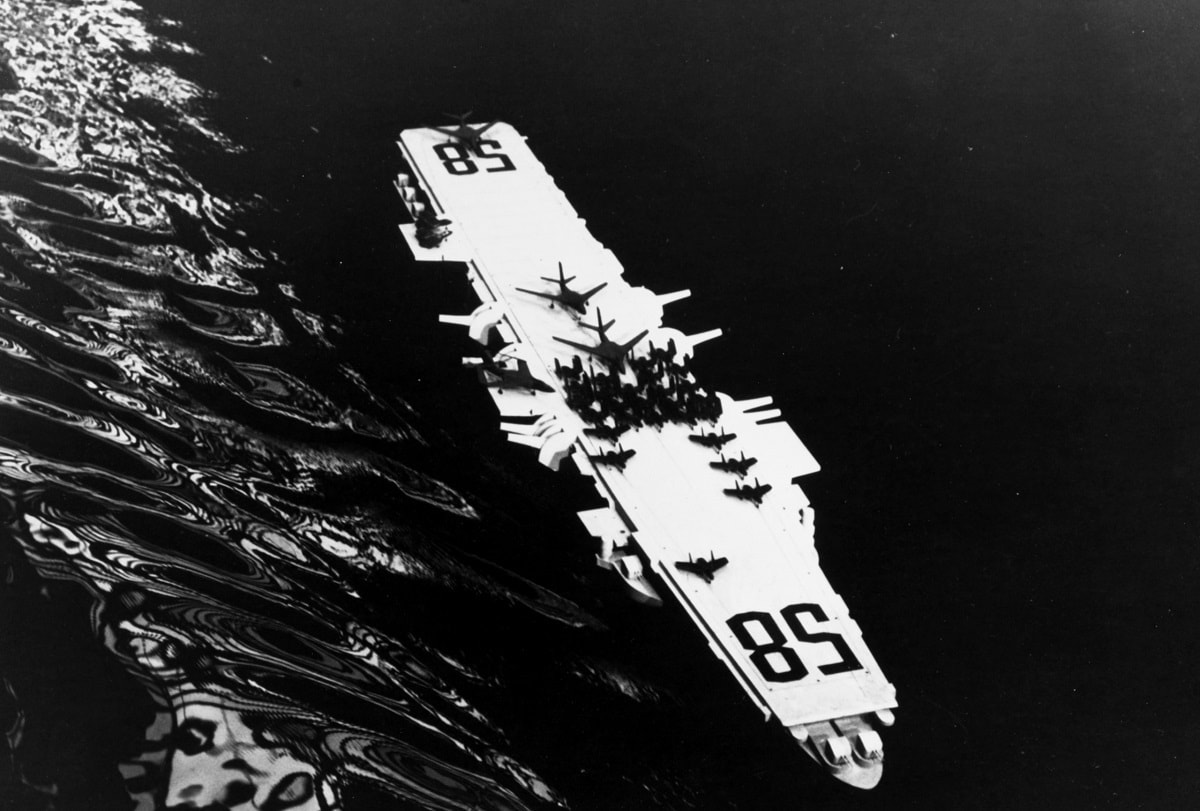
The USS United States (CVA-58) was supposed to be the lead ship of a new class of supercarriers. The CVA designation was murky but was either for attack or atomic. 

USS United States U.S. Navy Aircraft Carrier.
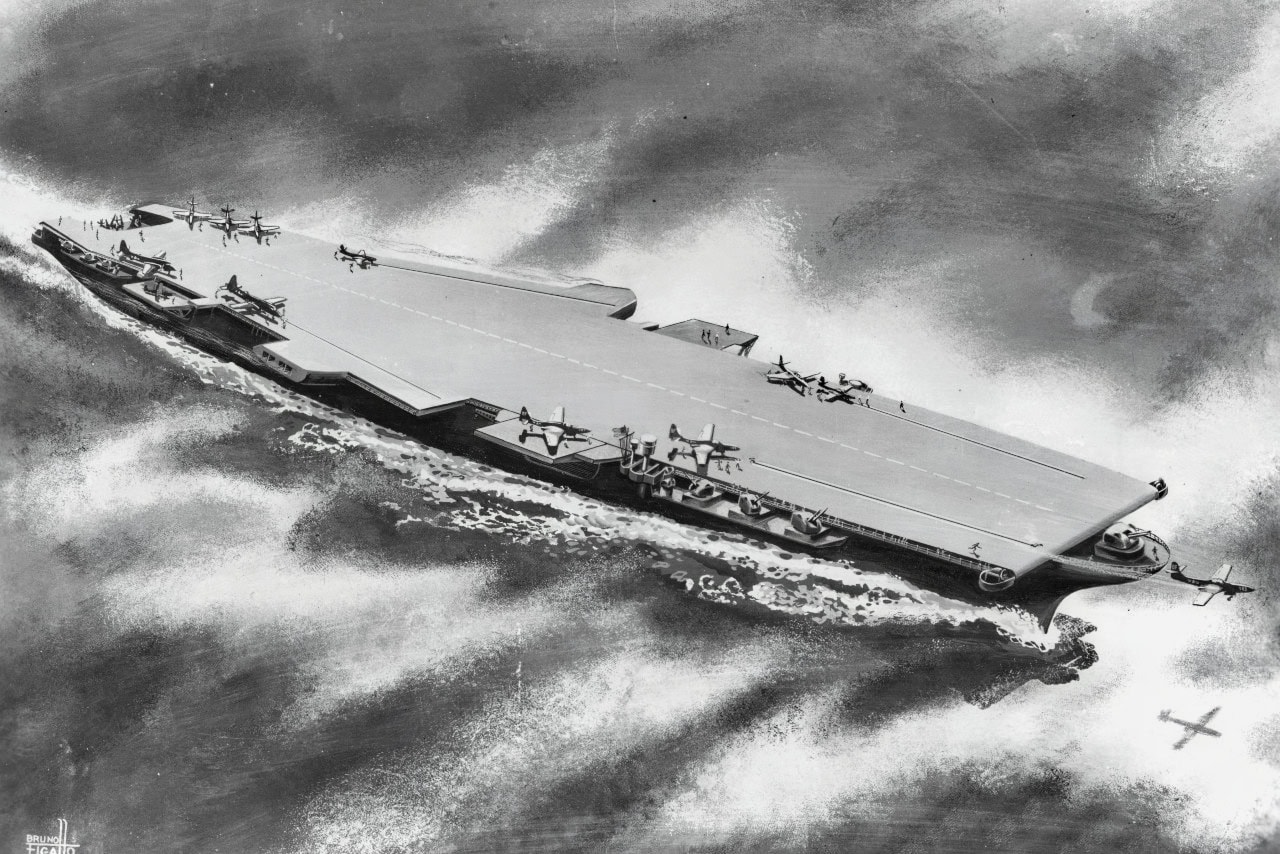
[ed: strange design, for sure]

 President Truman approved the construction of the new class of carriers after funds were provided in the Naval Appropriations Act of 1949. The design was quite the radical departure from the World War II-era flattops, and in essence, seemed unfinished as it was indeed a flat top with no island. 

The proposed 65,000-ton carrier (83,000 tons fully loaded) would feature a flush deck designed to launch and recover large aircraft up to 100,000 pounds. It could also carry the nuclear weapons of the era, which weighed as much as five tons. 

With no island, there wasn’t a place for radar, air operations, and command and control, which were nearly impossible. It had to be handled from a sister command ship. This meant the USS United States would be a floating air base. 

Older carriers were constructed before nuclear power plants were even thought of. The old power plants generated a lot of smoke, with no island and no stack; where does the smoke go without interfering with air operations on the deck? That would be a significant issue in diverting the smoke safely.

The Air Force Wanted the Program Canceled

The new US Air Force, as previously mentioned, thought that the Strategic Air Command (SAC)—with the latest heavy bombers that could carry nuclear weapons—was the be-all, end-all. However, the Navy under Admiral Marc Mitscher, who was involved in many of the most significant Pacific operations during World War II, wanted the Navy to get its piece of the pie. 

What Mitchser wanted was an aircraft carrier capable of launching nuclear-armed strategic jet bombers off its decks to attack military installations of the Soviet Union or any future enemy. 

USS United States Aircraft Carrier
model of CVA 58 in tank testing

However, the urge to get big nuclear bombers on Navy flight decks blinded the Navy brass to flaws in the design of CVA-58. The ship’s armament consisted of a full battery of eight five-inch guns, 16 76-mm autocannons, and up to 20 smaller 20 mm Oerlikon anti-aircraft guns.

When the ship was approved for construction, Air Force Chief of Staff General Hoyt S. Vandenberg sent a memo to Secretary of Defense James Forrestal defining in no uncertain terms the service’s position on the “supercarrier.” Its purpose was “to prevent Congress” from further committing to approving the carrier.

USS United States Aircraft Carrier: Construction Stopped in 5 Days 

Much infighting took place over the “supercarrier,” with the heads of the Joint Chiefs lobbying for support. This was referred to as “The Revolt of the Admirals, because of how hard the Navy fought for this project. Then, the project was abruptly canceled just five days after the keel was laid.

Things eventually worked out for the Navy. They instead got the Forrestal-class carriers at the start of the Korean War.

However, the bad blood between the Navy and Air Force continued well after that, and some would claim that even today, that is why the services operate the way they do. 

                                                         ~~~~~~~~~~~~~~~~~

We have to admit, that is one strange looking vessel - and we can only imagine the problems that would have cropped up had it been built! As the article mentioned, radar, command and control spaces, and a myriad other issues. Actually saved some money on that decision! 

Stay warm folks, and be safe!

Until next time, 

                                                       Fair Winds,

                                                  Old Salt


Sunday, January 19, 2025

OUT WITH THE OLD - IN WITH THE NEW


 19 January 2025: As the new year advances, all kinds of change are happening. Everywhere. And now, the last remaining conventionally powered U.S. aircraft carrier is officially done - even though she had been in "mothballs" for five plus years! From Business Insider, the John F. Kennedy heads for the scrap yard.

                                           ~~~~~~~~~

The decommissioned aircraft carrier John F. Kennedy embarked on its final journey to be dismantled earlier this week.The Kennedy was moored at the Navy's Inactive Ships Maintenance Facility in Philadelphia for nearly two decades before being sold to scrap dealers for just a cent.

 The decommissioned aircraft carrier John F. Kennedy is towed to the Navy Inactive Ships Maintenance Facility.

The Kennedy namesake will live on in the future Ford-class nuclear-powered aircraft carrier. PCU Kennedy, the second-in-class ship, is scheduled to be commissioned in 2025, three years behind schedule.

Commissioned in September 1968, the Kennedy was the fourth and final vessel in the Kitty Hawk class, initially designated as an attack aircraft carrier.

Comprised of the first-in-class Kitty Hawk, USS Constellation, USS America, and the Kennedy, the vessels were the last group of carriers to be powered by fossil fuels, which were replaced by the Navy's Nimitz-class nuclear-powered flattops.

The name honored the president slain five years before, who had served as a naval officer during World War II. After his motor torpedo boat was rammed and sunk by a Japanese destroyer, he famously helped save his men from the water and relayed their stranded location to nearby allies by writing on a coconut husk.

After undergoing heavy modifications to adapt to a broader range of missions, the Kennedy became a class of its own, changing its classification to CV-67.


Nicknamed "Big John," the Kennedy completed 18 deployments over nearly four decades in service, including operations in the Mediterranean, Tyrrhenian, Ionian, Ligurian, Aegean, and Adriatic Seas.

USS John F. Kennedy aircraft carrier approaches the Japan-Egypt Friendship Bridge during transit of the Suez Canal
In the Suez Canal

In 2005, the Navy decided the cost of the maintenance overhaul for the aging carrier outweighed the benefits, opting to retire the ship instead. The aircraft carrier was taken out of service in August 2007 and towed to Philadelphia, moored alongside other inactive Navy vessels.

The Kennedy was notably involved in the Arab-Israeli conflict in the 1970s and deployed to the Middle East as part of the US response to the Yom Kippur War in 1973.

The vessel was also sent to waters off the coast of Lebanon after a suicide bomber struck the US Marine Corps Multi-National Forces Barracks at the Beirut International Airport, killing 241 Marines.

Aircraft aboard CV-67 launched the first major strikes on Iraq on the night of January 17, 1991, lighting up the night sky as the 80 sorties flying over Baghdad were pummeled with heavy fire from below.

"Imagine the Disney World light show, then magnify it 100 times," one pilot said. "That's what it looked like from the sky last night… it was incredible!"

The Kennedy and its battle group were also briefly deployed to the mid-Atlantic coastline to support the Nimitz-class carrier USS George Washington, establishing air security following the terror attacks in New York City on September 11, 2001.

"While John F. Kennedy Battle Group's services were needed for only a brief time, every member of the Battle Group was proud of their role in Operation Noble Eagle, providing security along the eastern seaboard of the United States," an observer with the Kennedy's battle group wrote, per the Navy.

The Kennedy also played an early role in the war in Afghanistan, launching the first air strikes off the coast of Pakistan that commenced Operation Enduring Freedom.

Not only will the Kennedy go down in history for its involvement in key conflicts in US history, but it was also the setting of one of the greatest military pranks of all time.

A Navy tradition dating back to the 1960s, crews aboard Navy aircraft carriers would prank the sailors aboard the relieving ship by releasing greased pigs on its flight deck.

When the Kennedy was set to relieve the Kitty Hawk-class supercarrier USS America in 1986, aviators aboard the America dropped off an unusual payload on the new arrivals: three greased pigs dyed with red, white, and blue food coloring.

In 2021, the Navy sold two old aircraft carriers — the Kennedy and the Kitty Hawk — to scrap dealers for just one cent each.

Though towing and breaking down the ship for scrap is a costly process, the profit from selling scrap steel, iron, and non-ferrous metal ores will benefit the company.

Departing from the Philadelphia naval facility, the ship is set to sail into Delaware Bay and into the North Atlantic Ocean before transiting south, around the Florida peninsula, and then across the Gulf of Mexico.

After 17 years at the Navy's decommissioned ship facility, Big John embarked on its final voyage to International Shipbreaking Limited's scrap metal yard in Brownsville, Texas.


The aircraft carrier USS John F. Kennedy sails at sunrise off the coast of Boston. 

Expected to be delivered The Kennedy namesake will live on in the future Gerald R. Ford-class aircraft carrier.to the Navy in the summer of 2025, the second-in-class PCU John F. Kennedy touts a hefty $11 billion price tag — albeit $2 billion shy of the $13 billion first-in-class USS Gerald R. Ford.

Measuring 1,092 feet in length — only a few feet shy of the height of the Eiffel Tower — the future Kennedy will be able to accommodate more than 75 aircraft.

A rendering shows the future aircraft carrier John F. Kennedy, the second ship in the Gerald R. Ford class.
a rendering of the new JFK

 Powered by two nuclear reactors, the Navy said its newest warship will incorporate nearly two dozen technological upgrades to make it more efficient, including improvements in propulsion, power generation, ordnance handling, and aircraft launch systems.

''USS John F. Kennedy will carry the legacy of its namesake and the power of our nation,'' then-acting Navy Secretary Thomas Modly said in a 2019 statement. ''The advanced technology and warfighting capabilities this aircraft carrier brings to our global challenges will strengthen our allies and partners, extend our reach against potential adversaries, and further the global mission of our integrated naval force.''

                                 ~~~~~~~~~~~~~

As we said at the outset, out with the old and in with the new! 

Until next time,
                                    Fair winds,
                                              Old Salt