Thursday, July 4, 2024

USS CYCLOPS VANISHES

4 July 2024: To all our American readers, Happy Birthday America! 248 years young. We hope your day is safe and enjoyable; take a moment to reflect on the price we have paid for our independence! 

Continuing on the path away from shipwrecks and recovery, we offer, from Stars and Stripes, the following on the disappearance of the collier USS Cyclops in the so-called Bermuda Triangle.

                                             ~~~~~~~~~~


(Tribune News Service) — The telegram was dated April 14, 1918; the time stamped 2:34 a.m. It was addressed to Henry E. Battle, a prominent physician in Andalusia, Ala. The contents would cause Battle’s wife, Jessie, to go into, as the local newspaper described it, “a state of collapse.” The telegram said: “The Navy Collier Cyclops on which your son, Lee Otis Battle, seaman second class, U.S.N., was a member of the crew is overdue at an Atlantic Port since March thirteenth. … Her disappearance cannot be logically accounted for in any way as no bad weather conditions or activities of enemy raiders have been reported in the vicinity of her route. Search for her is being continued by radio and by vessels…”

Lee Otis Battle’s unknown fate was also editorialized in that same edition of The Andalusia Star, where writers remarked that “the anxiety and uncertainty of it all, with the faint hope that news may yet come that all are safe, and yet with the still more probable likelihood that all went down with the ship, makes the situation all the more trying on the grief-stricken father and mother of this young hero.” The editorial continued: “We think of Otis as the bright, happy, and companionable boy – a favorite among his associates. We hope that news may yet come that he and all who are on board are still safe. But if what we fear shall prove to be true and it proves to be that Andalusia’s first victim was our own jolly Lee Otis, we feel assured that since we know he met duty like a true American we also know that he met death, if death has come, like a hero.” 

The Battles would never learn what happened to their son, nor would the families of the other 292 passengers and crew – including 11 other sailors from Alabama – who were aboard the Cyclops when she disappeared. None was ever seen again, nor was any trace of the ship discovered. “There has been no more baffling mystery in the annals of the navy,” said Secretary of the Navy Josephus Daniels in a December 1918 report circulated by the United Press in newspapers nationwide. 

The Bermuda Triangle:

 When the World War I ship vanished sometime after March 4, 1918, the collier was loaded with a cargo of manganese to make munitions for the war effort. She had last stopped in the British West Indies for coal and was headed to Baltimore, Md. The term “Bermuda Triangle” or “Devil’s Triangle” wouldn’t be popularized until the mid-20th century, but legends about mysterious disappearances in the area had been whispered for decades. When the Triangle – roughly Florida to Bermuda to the Greater Antilles – did become part of sea lore, the Cyclops was quickly listed as one of its victims, along with at least 50 other ships and 20 other planes that had crossed into the “cursed’ airspace or sea lanes. Adding to the air of mystery was the fact that two of the Cyclops’ sister ships (there were a total of four Proteus Class ships built before WWI) were also lost in the Triangle, although much later. The USS Nereus and USS Proteus both vanished at sea, in 1940 and 1941, respectively, not long after they had been sold to civilian operators. Crews of both ships were lost.

 Alabama sailors:

 Although no bodies or wreckage were found after the Cyclops went missing, one Alabama seaman was laid to rest in a cemetery with a headstone. Austin Mize had celebrated his 18th birthday just weeks before the ship’s last contact on March 4. After the Navy declared all on board the Cyclops dead, Mize’s family erected a headstone at Liberty Presbyterian Cemetery in Odenville, Ala. The inscription reads: Forman Austin Mize Feb. 13, 1900 Lost On U.S.S. Cyclops March 1918 Gone But Not Forgotten. 

So what might have caused the loss of the Cyclops? Theories that involve the Bermuda Triangle include: A supernatural element: The area is cursed and causes ships and planes to crash/sink/vanish. The geophysical element: Mariners do not account for the agonic line, the place at which there is no need to compensate for magnetic compass variation as they approach the Bermuda Triangle, which can result in navigational error. The environmental element: Rogue waves, once called tidal waves, are more likely to occur in the area of the Triangle because storms can converge from multiple directions. The waves, which can reach 100 feet high, are thought to be “powerful enough to destroy all evidence of a ship or an airplane,” according to Britannica.com. Outside of the Bermuda Triangle, theories include issues with the ship, or possible wartime sabotage. Some experts believe that the load of manganese was more than the ship’s capacity and could have caused the ship to overturn. In addition, the ship’s lieutenant commander, George W. Worley, had reported before leaving Bahia that a cylinder had cracked on the starboard engine. Also, a severe storm was reported on March 10, but it is uncertain if that contributed to the disappearance of the Cyclops. German officials at the time denied making contact with the Cyclops. The United Press article in 1918 reported: “Probably not until the sea gives up its secrets will the fate of the Cyclops be known.” Once the Navy declared all aboard lost, the date of death assigned for those on board was June 14, 1918.

                           ~~~~~~~~~~~~~~

OK - so not a ship wreck (none was ever found) and obviously, no recovery. The Cyclops story is just one of many about disappearances in the so-called Bermuda Triangle, both ships and planes. Theories abound, but none can be proven with any degree of certainty. 

Happy Independence Day, America!

Until next time, 

                                 Fair Winds,

                                             Old Salt


Sunday, June 23, 2024

SS UNITED STATES BEING EVICTED

 23 June 2024: June winds down with oppressive heat and strong squalls troubling the U.S. Northeast. I would say "global warming" except it's summer and it often gets hot during the summer.... and some summers are hotter than others! So, maybe or maybe not. But just to be safe, keep driving EV cars and don't run your air conditioner! I am astonished to reveal that Maritime Maunder has surpassed 200,000 readers with the last post. Truly amazing as we close in on the conclusion (August) of our 10th year and possibly begin number 11! 

As a matter of interest, we have heard from a couple of you that we focus too much on the discovery and recovery of ship wrecks and maybe we should offer some other type of maritime stories that might be of interest. So, from Stars and Stripes, the following on the S.S. United States:

                                               ~~~~~~~~~~~~~~~

PHILADELPHIA — The SS United States, a historic ship that still holds the transatlantic speed record it set more than 70 years ago, must leave its berth on the Delaware River in Philadelphia by Sept. 12, a federal judge says. The decision issued Friday by U.S. District Judge Anita Brody culminated a years-old rent dispute between the conservancy that oversees the 1,000-foot ocean liner and its landlord, Penn Warehousing. It stemmed from an August 2021 decision by Penn Warehousing to double the ship’s daily dockage to $1,700, an increase the conservancy refused to accept. When the conservancy continued to pay its previous rate, set in 2011, Penn Warehousing terminated the lease in March 2022. 

In her berth on Philadelphia waterfront

After much legal wrangling, Brody held a bench trial in January but also encouraged the two sides to reach a settlement instead of leaving it up to her. The judge ultimately ruled that the conservancy’s failure to pay the new rate did not amount to a contract breach or entitle Penn Warehousing to damages. But she also ruled that under Pennsylvania contract law, the berthing agreement is terminable at will with reasonable notice, which Penn Warehousing had issued in March 2022. “The judge’s decision gives us a very limited window to find a new home for the SS United States and raise the resources necessary to move the ship and keep her safe,” Susan Gibbs, conservancy president and granddaughter of the ship’s designer, told The Philadelphia Inquirer. Besides finding a new home, the conservancy also must obtain funds for insurance, tugs, surveys and dock preparations for a move. “The best hope of everyone involved was that the conservancy could successfully repurpose the ship,” said Craig Mills, an attorney for Penn Warehousing. “But after decades of decay and delay, it is time to acknowledge the unavoidable and return Pier 82 to productive commercial service.” 

Christened in 1952, the SS United States was once considered a beacon of American engineering, doubling as a military vessel that could carry thousands of troops. On its maiden voyage in 1952, it shattered the transatlantic speed record in both directions, when it reached an average speed of 36 knots, or just over 41 mph, The Associated Press reported from aboard the ship. On that voyage, the ship crossed the Atlantic in three days, 10 hours and 40 minutes, besting the RMS Queen Mary’s time by 10 hours. To this day, the SS United States holds the transatlantic speed record for an ocean liner. 

Leaving NY Harbor for Europe 3 July 1952 Maiden Voyage

It became a reserve ship in 1969 and later bounced to various private owners who hoped to redevelop it but eventually found their plans to be too expensive or poorly timed. It has loomed for years on south Philadelphia’s Delaware waterfront.

                                           ~~~~~~~~~~~~~~~~~~~~~

So, no shipwrecks or recovery this time - and obviously there will be more to this sad story going forward. We surely hope the conservancy can generate enough funding to save this historic vessel. Maybe a hotel or fancy restaurant - or both! Similar concept to the SS Queen Mary in Long Beach Calif! [ed: Wow! 200K readers! Hard to believe!]

Until next time,

                                      Fair Winds,

                                              Old Salt 


Sunday, June 9, 2024

U 505 CAPTURED

 9 June 2024: Here we are through the first week of June and the weather is starting to look a little "summery" here in the U.S. Northeast. We just celebrated the 80th anniversary of D Day - the world's largest maritime invasion and the liberation of Europe - and the occasion was marked by every country that participated, and many of the surviving members - now 100 years old and over - of that amazing event were present in person on the beach in Normandy, France, remembering those who died and the sacrifice so many made. Over 9,000 died that day and during the following several days. Visiting the American Cemetery, with its seemingly endless white marble crosses and Stars of David lined up in military precision overlooking the beaches of Normandy is truly a moving experience.


The following piece fits the timeline of D Day as you will see, though it had little to do with the actual invasion, it did have a marked impact on the rest of the war. From Task & Purpose.com:

                                                 ~~~~~~~~~

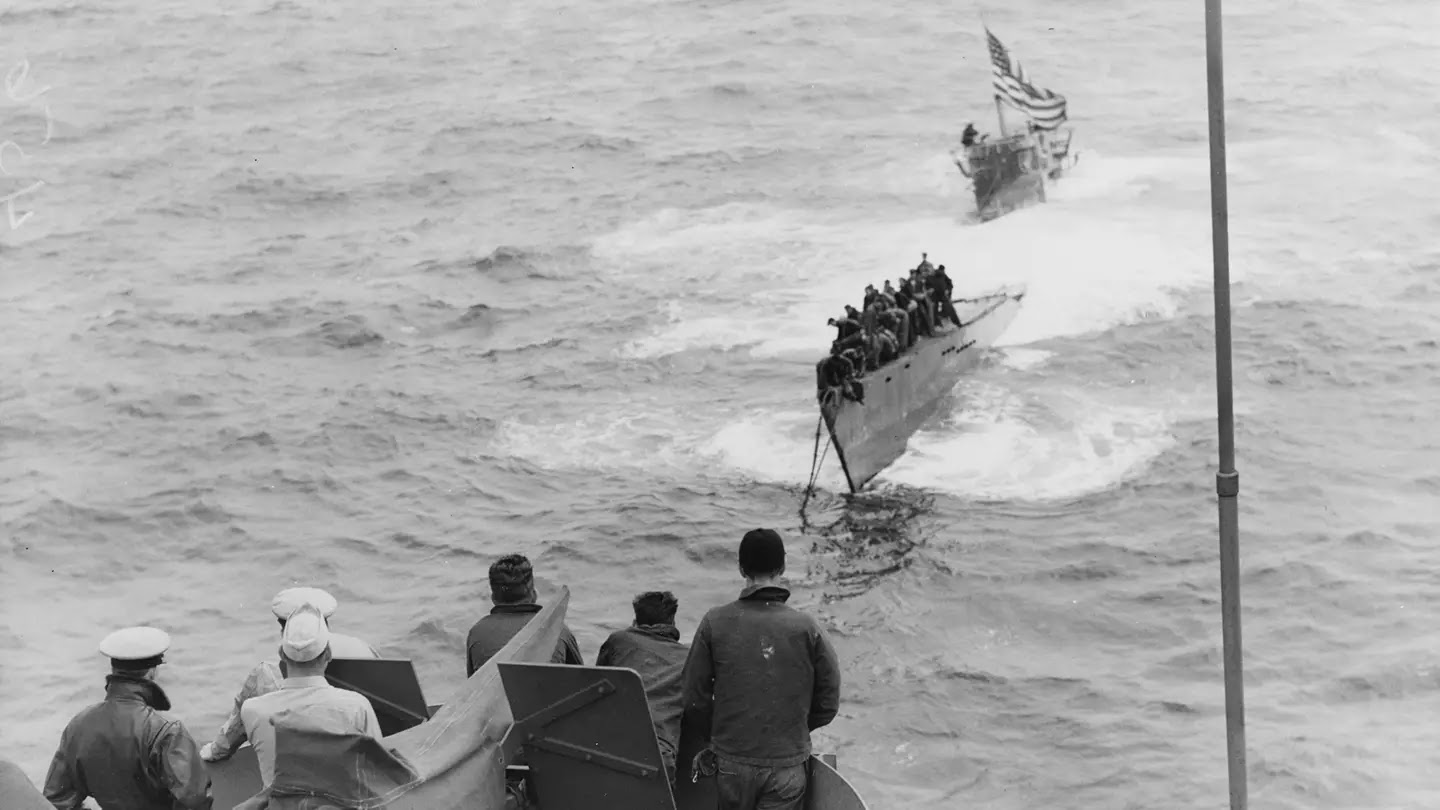
Several American sailors climbed aboard the German submarine U-505, focused on saving it from sinking into the depths of the Atlantic Ocean. They did not know if the Nazi submariners who dove overboard had set scuttling charges beforehand, but the risk was worth it: the wealth of intelligence on board could help them shorten the time needed to crack messages from the elusive Enigma machine. 

It takes a heroic amount of intestinal fortitude to board a sinking ship rigged with 14 demolition charges for the express purpose of preventing the U-boat from being captured. But on June 4, 1944, the U.S. Navy successfully captured U-505, a German Type IX-C submarine. 

U 505 under tow to keep it from sinking

 The concept of capturing a German submarine was hatched after a Navy hunter-killer team named the Guadalcanal Task Group had successfully destroyed a Nazi U-boat in 1943. After hammering U-515 with depth charges from both Naval destroyers and aircraft, it was damaged beyond saving. The Nazi commander ordered the submarine to the surface, where the U.S. Navy hammered it again, causing it to catch fire, explode, and sink. 

Daniel V. Gallery​​, the former commander of the USS Guadalcanal Task Group, recalled how they planned the capture of U-505 during an interview recorded on May 26, 1945, and archived by the Naval History and Heritage Command. 

“In analyzing this attack afterward, it occurred to us that if we had anticipated what was going to happen and had been ready for it with organized boarding parties, we might possibly have gotten aboard the U-515 in time to save her,” Gallery said during the interview. “So we determined that on the next cruise, we would anticipate such an event and be ready for it.”

Each ship trained boarding parties with the plan to quickly board a submarine, disable scuttling charges, and pump out all the seawater from the damaged or intentionally opened valves. They had orders to remove as much classified material and intelligence as possible, knowing a damaged U-boat could be torn apart by explosives or sink at any minute.

Working on some of the latest intelligence on submarine locations, the task group searched for U-boats along Africa’s western coastline. They hunted a U-boat for several days, having disappearing sonar contacts and various other detection devices intermittently triggered by a U-boat presence. 

But one Sunday morning, at about 11:10, 150 miles west of Cape Blanco, the U.S.S. Chatelain reported that she had a contact on the submarine they’d been hunting. The Chatelain launched their first attack on the Nazi submarine with hedgehogs, which were v-shaped mortars that launch multiple depth charges in a pattern. The U-505’s commander, Capt. Harald Lange, ordered two torpedoes fired at the hunter-killer group. 

Two General Motors FM-2 “Wildcat” fighter planes from the escort carrier Guadalcanal spotted U-505, marked it with gunfire, and the Chatelain hit the area with the hedgehogs again. This time, oil started bubbling up, and the U-505 surfaced seconds later. 

The Nazi sailors tried manning their deck guns, but gunfire from the task group killed one of the Nazi sailors and forced everyone else overboard, including the submarine commander. U-505 had sustained major damage and its rudder was jammed, lights and electrical machinery out, and rapidly taking on water. 

An eight-man boarding team from the U.S.S. Pillsbury quickly caught up to the runaway U-boat and boarded while other teams were sent out to pluck the Nazi sailors from the water. Because the Germans evacuated so quickly, one of the diesel engines was left on, and the submarine started circling toward the task group. 

“They didn’t know what was down below,” Gallery said. “They had every reason to believe, from the way the sub was still running, that there were still Nazis left below engaged in scuttling, setting booby traps, or perhaps getting rid of confidential gear.” 

The boarding party didn’t find anyone in the submarine, but the ever-looming threat of the sinking ship was heavy on their minds as they hurried to collect intelligence and prevent any more seawater from entering.

While the boarding party worked, the Pillsbury tried to pull alongside the submarine twice, and the submarine’s bow pierced the destroyer each time, forcing the destroyer to maneuver away to address their flooding compartments.   

The boarding party plugged leaks and sealed the open valves letting water in. They attached tow lines and the Guadalcanal towed the U-boat at high speed, turning the electric motors over, and recharging the boat’s batteries. The American sailors aboard then used the U-boat’s pumps and air compressors to pump out the rest of the water, bringing the submarine back to the surface.

By the time the task group’s ships reached their destination in Casablanca, they were about to run out of fuel. The intelligence gathered from U-505 was invaluable, and included 900 pounds of codebooks and documents and two Enigma machines with the latest “Shark” coding. 58 Nazi sailors were captured and the U.S. and her allies had to keep the captured U-boat a secret. Hiding a 700-ton submarine proved to be a challenge almost as difficult as the capture itself. 

The U-505 was the largest intelligence victory during the WWII battle for control of the Atlantic Ocean. The seized documents and codebooks allowed U.S. Navy code-breaking teams to cut at least 13,000 computer hours, a major help for their decoding work for the rest of the war.

The U-505 was one of six U-boats captured during WWII, and every submarine captured provided valuable intelligence for locating and destroying the rest of the Nazi’s naval fleet. 

                                             ~~~~~~~~~~~~

The U-505 is on display in Chicago, ILL at the Museum of Science and Industry,  and is open to visitors. How it got there might be the subject of a new post.... Also, there was a movie, called, appropriately, "Attack and Capture" which appeared in 2002 on television. Not quite historically accurate, but that's not really a surprise, given Hollywood's proclivity for embellishment! 

Until next time,

                                           Fair Winds,

                                                   Old Salt