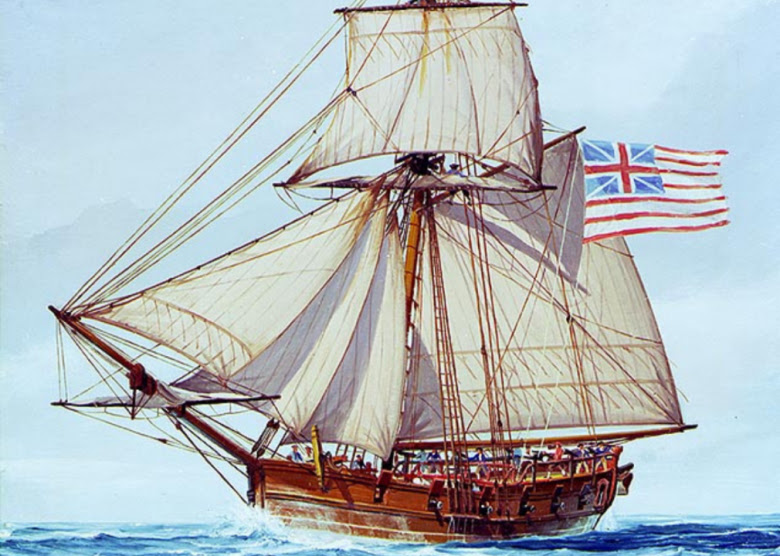
12 June 2022: Last week we talked about one of the more famous - and certainly significant - ships in the U.S. naval service. This weeks post will take a look at the more significant vessels to fly the U.S. flag from the American Revolution to today. Obviously, that is a huge and lengthy subject so we'll be doing it in several posts; this one and perhaps two more depending on how long they turn out to be. We will try to do it on successive weeks (for purposes of continuity) but sometimes we need a "palette cleanser" to improve the next course. So, stay tuned and we'll see how the story unfolds as well as where the interest of our readers lie. This lengthy research was done by "Stacker" at WUN (an on line service). At the outset, let me offer that the articles all refer to American ships as "USS" (United States Ship), but as we have mentioned before, that prefix didn't occur until the presidency of Theodore Roosevelt in 1905. Prior to then, ships were designated by their design/purpose/rig, i.e. United States Frigate Constitution or U.S Schooner Hannah. So, as you read this and the follow on, keep that fact in mind.
~~~~~~~~~~~~~~~~
If a sailor in 1530 magically teleported through the future to the dawn of
the American Revolution in 1775, he likely would have been able to get a job
aboard a ship in the Continental Navy. Of course, he would have encountered new
technologies, new instruments, and new terminology, but the vessel’s riggings,
sails, components, cannons, and functionality would have been
most familiar. But if a sailor in the Continental Navy teleported the
exact same 245 years through the future to 2022 and landed on a U.S. Navy
aircraft carrier or a nuclear submarine, he might as well have landed on a
spaceship.
The nearly 2 1/2 centuries from when the original colonies first began
organizing for maritime battle against their British oppressors to
today have witnessed the greatest evolution of naval warfare in human
history. The United States and its Navy have fought 12 major wars in those 245
years. That’s an average of a major war every 20 years—not to mention countless
actions, security missions, skirmishes, and standoffs.
Each war introduced new naval technology, new tactics, new weaponry, and
most importantly, new ships. What started as a single vessel commissioned by
frustrated colonists has grown into roughly
300 ships and more
than 300,000 personnel in a fighting organization that has dominated the
world’s oceans unchallenged for 75 years.
Using government sources like the U.S. Navy’s own archives, as well as
historical accounts, news reports, museum databases, and official records of
individual ships, Stacker profiled 50 of the
most important and consequential warships in American history. Some vessels on
this list stand out for their incredible records in battle. Others are
noteworthy for the new technologies they introduced. All, however, have earned
a place as floating tributes to America’s military preoccupations,
technological ingenuity, and ability to project power and enforce its will
in the as tensions rose in the run-up to the Revolutionary War, the
British launched a campaign to harass, stop, board, search, and seize American
merchant ships, nowhere more aggressively than off the shores of Rhode Island.
 |
| Katy |
In June 1775, the tiny colony’s legislature authorized the conversion of the Katy—a
former whaling, merchant, and privateer ship—to be armed, outfitted, and
transformed from a sloop to a sloop-of-war. The ship that would go on to become
the U.S.S. Providence was charged with the modest task of single-handedly
defending Rhode Island against the British Empire, whose invincible navy had
ruled the world’s seas since defeating the Spanish Armada at the end of the
16th century.
Realizing that the Katy wouldn’t be able to fend off the British empire on
its own, George Washington began personally procuring more capable ships. The
first among them was the schooner
Hannah, which Washington bought on Aug. 24, 1775—it captured its first
Royal Navy sloops just a few weeks later in early September. The first armed
naval vessel to fight in the Revolution and the first to sail under Continental
control, the Hannah is considered the founding vessel of the U.S. Navy.
 |
| Hannah |
The second of those first two ships was the
Cabot. After sailing out of Boston it soon ran into the HMS Milford, a far
more capable British vessel. After being forced aground in Nova Scotia, it
became the first American ship ever to fall into enemy hands when the British
captured it and refitted it for service in the Royal Navy.
The United States Navy recognizes Oct. 13 1775, as its birthday the day
that the Continental Congress authorized the creation of a single, unified navy
instead of a patchwork of fleets controlled by individual colonies. It
authorized the purchase of two ships to conduct raids on the British, the first
of which was the converted merchant brig Andrew
Doria, which would soon fight in the Battle of Nassau, the first
major maritime combat of the Revolution. The Continental Navy was born.
 |
Andrew Doria
|
The era of the Continental Navy came
to an end when the expensive fleet was disbanded after the Revolutionary War.
The last of the commissioned Continental warships was the
frigate Alliance, which fired the last shots of the American Revolution.
SIX FRIGATES
More than a decade into America’s infancy as a country, it
became clear that the pirates known as the Barbary corsairs, who terrorized
merchant ships from their North African strongholds, understood only the
language of force. No longer under the protection of Great Britain, American
vessels were fair game to the relentless pirates, whose campaign of terror,
kidnapping, and extortion compelled the U.S. Congress to pass the Naval Act of
1794. The act authorized the construction of what are now known as the ‘Original
Six’ frigates of the United States Navy, which would sail under the title
United States Ship (USS): USS President, USS Constellation, USS Chesapeake, USS
United States, USS Congress, and the most storied ship in American naval
history, the USS Constitution.

First launched in 1797, the USS
Constitution remains the world’s oldest commissioned ship still afloat and
is the official Ship of State of the United States of America. The timbers of
the three-masted heavy frigate’s hull were so thick that cannonballs frequently
bounced off of them, giving the Constitution its famous nickname “Old Ironsides.”
With an other-worldly battle record in the Barbary Wars, the Quasi-War with
France and, most notably, the War of 1812, the Constitution represents
America’s earliest ability to project force in distant lands—the undefeated
ship was never boarded or beaten in battle.
The
USS Essex was another prime example of excellence in the early “Old
Navy”—as America’s pre-1882 fleet is now called—tallying significant battle
success in the Quasi-War with France, the First Barbary War, and the War of
1812. The frigate was the first American ship to sail around the notoriously
perilous Cape Horn to the open Pacific Ocean, where it terrorized Great
Britain’s whaling fleet. Its success became a burden, however, when the British
finally dedicated two of its best ships to hunting down the Essex, which they
eventually captured and pressed into the service of the Crown.

The USS Independence
was the U.S. Navy’s first ship of the line, the biggest, most powerful warships
of the day. The Independence was part of a large and heavily armed squadron
that the Navy sent to North Africa to end the reign of the Barbary Coast
Pirates once and for all. When the squadron arrived in Algiers after taking
several Algerian ships on the way, the intimidation factor alone was enough to
force the enemy to accept a peace agreement, guarantee U.S. trade rights in the
region, and return the men and ships they had captured.
Built in the closing days of the War of 1812, the
Demologos was a wooden floating battery designed to defend New York Harbor
from the British Navy. An otherwise unremarkable vessel, it represents a
before-and-after moment in the history of naval warfare as it was the first
warship ever to be propelled by a steam-powered engine. |
| Demologos |
The War of 1812 came to a close when the sloop-of-war USS
Peacock captured East India Company brig Nautilus in the last naval action
of the conflict. The U.S. Navy wouldn’t capture another enemy ship until World
War II. The Peacock also holds the distinction of being the first ship the
United States ever outfitted for scientific exploration when it was sent to
explore and survey the farthest reaches of the mighty Pacific Ocean.
~~~~~~~~~~~~~~~~~~
I have to offer that some of these ships were new to me and while obviously significant, are pretty obscure. We all learn something new. So, that gets us through the War of 1812; next up will be Spanish American War and beyond. So, watch for that in the coming weeks. Until then,
Fair Winds,
Old Salt