Tuesday, April 11, 2017

OLD IRONSIDES ALMOST READY TO GO BACK IN


11 April 2017: Out of the water in Dry Dock # 1 in Charlestown Navy Yard (Boston), USS Constitution (Old Ironsides) has almost completed her overhaul which happens every 20 years. We posted a couple of years ago (Yes, She was put in dry dock almost 2 years ago) the story of her "haul out" with images of her crossing the sill. Now, the Boston Globe reports she is close to complete and will be refloated in July of this year. Here's the story:


The last surviving member of the US Navy’s original class of six frigates, the Constitution will return to the waters at Charlestown Navy Yard with nearly 100 new white oak planks and more than 2,200 fresh copper sheets on its recaulked hull.  


Though the ship won’t be fully outfitted for launch until September, the Navy said the end of the drydocking is an important step in the restoration process, which is required every 20 years to keep the historic vessel from falling victim to shipworms and other marine hazards.


The Constitution, the oldest commissioned ship in the Navy, operated from 1798 to 1854, earning the nickname Old Ironsides. It captured 33 vessels and is known for three victories* against British ships during the War of 1812.

During the restoration process, the ship has remained open to visitors. From April 15 through July 10, people will be able to check out the Constitution’s top deck from Tuesday through Friday from 2:30 to 6 p.m., and on Saturday and Sunday from 10 a.m. to 6 p.m.

Through April 14, the visiting hours are Thursday and Friday from 2:30 to 4 p.m. and Saturday and Sunday from 10 a.m. to 4 p.m.

 [*ed: there actually were four: Guerrierre, Java, Cyane, and Levant, the last two being beat at the same time!]
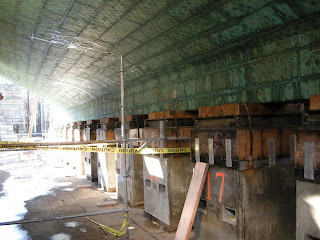

Starting July 10 and continuing into September, deck access will be limited so workers can restore its masts and other parts of its rigging and complete the restoration project, estimated to cost between $12 million and $15 million.

The Navy yard will remain open, however, and there will still be opportunities to see presentations about the ship and to interact with the crew. The ship returns to the water July 23 at midnight. 


Margherita M. Desy, a historian with the Naval History & Heritage Command Detachment Boston, said the project has been an opportunity to see the Constitution in its full majesty.

By exposing the area that normally sits below the water line, conservators and visitors have been able to catch a glimpse of how the four-story vessel towered over the North End when it was under construction there centuries ago, Desy said.


A view of the keel of Constitution. Officials say that about 2,200 of the 3,400 copper sheets have been replaced. 


“Every time the ship is taken out of the water and this extraordinary ship is revealed to us and our visitors . . . we once again marvel at the beauty of her design, the scale of the body of this very large warship,” Desy said. “It’s a privilege to have any opportunity to work on her and to work aboard her.”

The restoration has also given members of the public a chance to put a small mark on the ship. Many who visited the USS Constitution Museum wrote their names on sheets of copper that were later placed on the ship’s hull.

“It’s kind of fun that visitors to the museum over the past two years have literally been able to inscribe their names in history,” Desy said.

We will of course post here re-launch in July. 

For the next couple of weeks, we will be away (at sea) and will have very limited access to wifi, hence this may be the final post until May.... If possible, we will offer more, but it's not assured.

That's it for now (and maybe for a couple of weeks!)

                            Fair Winds,
                                        Old Salt


Thursday, March 30, 2017

A SAD STORY IN WASHINGTON STATE

30 March 2017: Last weeks post was fun, uplifting, and glorious to watch such a magnificent vessel, Endeavour, under sail. This week, sadly, we offer the other end of the spectrum, the story of Hero, a ship with a wonderful tale left to rot in Washington state. Courtesy of NPR news, herewith the tragedy of Hero: 


Driving up the coast toward Bay Center, Wash., it's obvious when you start to approach Willapa Bay. Fifteen-foot high piles of empty shells begin to appear on the side of the road. This is an oyster town.

But it's also home to a sinking piece of history.

Scott McDougall, director of the Pacific County Emergency Management Agency, points out what remains of the Hero, an Antarctic research vessel from the 1960s. The ship, which had been docked near Willapa Bay for a decade, sank on March 4 — McDougall was the first person to file a report. While walking across the street to the Palix River, he points out one of many inlets and waterways that feed into the bay.


"That's one of the beauties of Willapa Bay," McDougall explains. "There's all sorts of streams and tributaries that feed into it, and there's a good strong tidal inflow and outflow. This is one of the most pristine bays on the West Coast. And we have a lot of pride in that."

That sense of pride has been jolted by an oil sheen floating on the water's surface.
The Hero's faded green wooden bow, now covered in rust, peeks out of the water. By high tide, most of it will be underwater. That oil flowing from the wreckage is a huge concern for people that live and work here. Willapa Bay is where more than half of the state's oysters are grown.

"It has an adverse effect on the bay, it has an adverse effect potentially on their pocketbooks," McDougall says of the ship. "It has some fairly significant ramifications."

In its prime, the Hero sailed through frigid temperatures and ice-strewn waters in the South Pole. According to a 1968 article in the Antarctic Journal, the ship was named after the sloop of 20-year-old Nathaniel Palmer, a seal hunter who became the first person to sight Antarctica. Throughout the late 1960s and '70s, the boat carried scientists to and from Palmer Station, a research center on Antarctica's Anvers Island.


After the National Science Foundation retired the floating laboratory in 1984, a group of maritime enthusiasts purchased the Hero and created a foundation with hopes of restoring the vessel. But they failed to raise enough money and the Hero was sold to a private owner, who docked it in a river near Willapa Bay. For 10 years the Hero sat there, with little or no maintenance, before finally sinking earlier this month.

"This is a vessel with an amazing amount of history," McDougall says. "Just on a personal note, it makes me really sad to see what was once a beautiful vessel that was dedicated to promoting good ecology and good stewardship of the environment, to see it resting on the bottom and dying the death that it's dying."

Global Diving and Salvage, a Seattle-based company contracted by the state of Washington, has been helping with daily cleanup. Workers are using booms in the water and absorbent pads to soak up the materials. So far, they've removed about 1,000 gallons of oily water and more than 60 gallons of diesel fuel and petroleum.

"We're taking water samples and pictures every day and we're changing out the absorbents as we see fit," says Shawn Zaniewski, a spill responder with the Washington state Department of Ecology. "This is a very old vessel. There could be small containers of oil on board. As the tide goes up and down, it's going to continue to sheen like that until that stuff washes out."

"When you have a vessel this old and made of wood, all of the surfaces of the area are impregnated with oil," adds McDougall. "So, as long as the vessel is in the water, there's going to be a sheen that comes off of it."

Nobody knows that more than Dick Wilson, one of Bay Center's 276 residents. He moved to the area from Oregon in 1971 and has been farming oysters for more than 40 years. His business, Bay Center Mariculture, owns about 1,000 acres in the bay. His processing plant and storefront are just down the road, about 800 feet from the sinking Hero.

"It's something that shouldn't have happened," says Wilson, who drove down the hill from his house to check on the progress on the cleanup. "An incident like this is probably rather typical in a lot of places. But for here, it's abhorrent. We don't want it and it's something we just don't need in the bay."

Wilson and other local residents have been warning the state about the poor conditions of the Hero since it first arrived nearly a decade ago. The Department of Ecology is still investigating who owns the wreck — and who is liable for the environmental damage it's causing.
"You can't have a wooden boat and have it sit here for 10 years and not have it go to pot and leak," says Wilson. "That's just what they do."
For now, the future of how to remove the boat lies with the Washington state Department of Natural Resources.

"The department is researching ways to remove and dispose of the vessel, but every avenue we go down, there seems to be roadblocks," says Troy Wood, manager of the state's Department of Natural Resource's Derelict Vessel Removal Program.

According to Wood, the Hero's situation is unique. The 125-foot vessel is too large to carry down the river. He estimates lifting it out of the water would require the construction of two large land cranes on site. The cost of those cranes would greatly exceed the DNR's current budget.

With only $130,000 left in the biennium budget, a full-scale removal seems unlikely and unaffordable. Estimates on the cost of that project range from $750,000 to $1,000,000.

A sad story for anyone who appreciates our waters and the bounty we get from them.

Until next time, 
                              Fair Winds,
                                   Old Salt


Wednesday, March 22, 2017

J-BOAT ENDEAVOUR VIDEO

22 March 2017: Good morning and happy Spring, readers! A bit pressed today but I wanted to share a video, courtesy of Yachting World Magazine, of probably the most beautiful sailing craft ever to put to sea..... and I have seen her live some years ago. Here she is, still: 


For fabulous video click below:

Endeavour on the wind

Isn't she just gorgeous! And built in 1934!

Until next time, friends, 
                                      Fair Winds,
                                             Old Salt