10 November 2025: After the last post, we received some comments about the soporific nature of the post, so we thought to bring you something a bit more exciting this week.... as a matter of interest, the ship featured in this post held a special place in our memory, as USS Buckley sailed in the destroyer squadron with which I spent several years, DESRON ONE (San Diego) and I knew her well. Sadly, like so many of her contemporaries, she is gone now, either sunk for target practice or turned into razor blades. But this is an amazing story from Military.com.
~~~~~~~~~~~~~~~~~
The U.S. Destroyer Crew That Fought
a German U-Boat in Hand-to-Hand Combat
In an era of hypersonic missiles, stealth fighters, and nuclear subs, it’s
hard to picture sailors going toe-to-toe with the enemy on a ship’s deck. Yet
during World War II, the crew of a brand-new destroyer escort, USS Buckley,
did just that by slugging it out in hand-to-hand combat with German sailors
from U-66 in the middle of the Atlantic.
For centuries, naval battles were fought up close, with boarding parties
storming ships and melee weapons deciding victories. By the 20th century, those
days were seemingly long gone. But on May 6, 1944, the Buckley’s crew
proved that the basics of naval warfare were still useful.
Commissioned in 1943, the USS Buckley was a destroyer escort,
smaller than a destroyer, but built to protect Allied convoys from the
ever-present menace of German U-boats. Named after Aviation Ordnanceman John D.
Buckley who was killed at Pearl Harbor, the ship initially trained other escort
crews before joining the Battle of the Atlantic in spring 1944.
That May, Buckley joined Task Group 21.11, built around the escort carrier USS Block
Island. Their mission was to protect convoys and hunt U-boats. The work
was dangerous, but the escorts had radar, sonar, depth charges, and air cover.
It was supposed to be a battle of technology and maneuver, not fists, knives,
and coffee mugs.
Just after 3 a.m. on May 6, one of Block Island’s reconnaissance
aircraft, piloted by Lt. Jimmie Sellers, spotted U-66, a veteran
German submarine commanded by Oberleutnant zur See Gerhard Seehausen. The sub
was on its ninth patrol and had been out to sea since January. U-66
was worn down and in desperate need of supplies, so it surfaced to recharge its
electric engines and wait for assistance near the Cape Verde Islands.

Sellers relayed the U-boat’s position to the nearest American ship, the
destroyer escort Buckley. Lt. Cmdr. Brent Abel, her skipper, ordered
flank speed ahead to chase down the submarine.
Mistaking the Buckley for a friendly supply ship, Seehausen fired
three flares to make his position known in the dark. The U-boat quickly
realized its mistake and launched a torpedo at the approaching target. Buckley
managed to dodge it, though several sailors noticed it skim alongside their
ship. Moments later, the submarine’s machine guns opened fire, which was
answered by Buckley’s 3-inch guns and a storm of 20mm and 40mm shells.
The initial salvo hammered U-66’s deck and killed several crewmen.
Desperate, the U-boat fired another torpedo which skimmed across Buckley’s
bow as the destroyer escort turned hard to the right. The two ships closed to
within 20 yards, blasting away at each other in a fight that looked more like
an age of sail broadside than modern warfare.
Over the radio, Sellers narrated the engagement as he witnessed it from above, “Buckley
has opened fire, sub is returning fire. Boy! I have never before seen such
concentration! Buckley is cutting hell out of the conning tower!”
Abel decided to finish the fight the old-fashioned way. He ordered his ship
to ram the submarine.
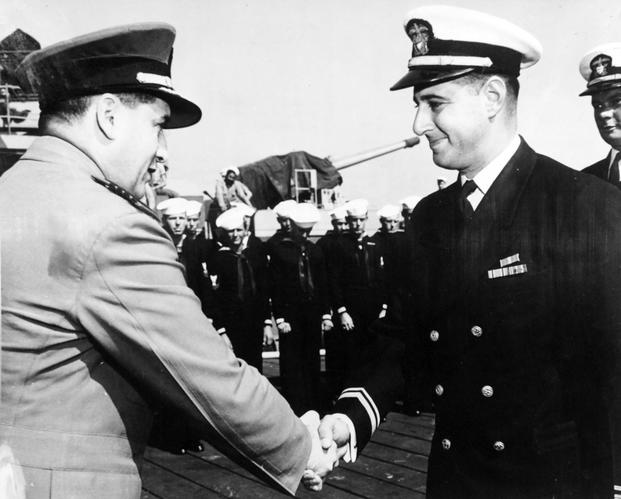
The destroyer escort smashed into the U-boat, locking the two vessels
together. Chaos unfolded. Some German sailors dove overboard while others
manned machine guns and the deck cannon. A handful of desperate submariners
grabbed knives, clubs, and wrenches and leapt aboard the Buckley.

The Americans were stunned as the order to repel boarders went out. Sailors
hurled shell casings, coffee mugs, kitchenware and even a full coffee pot at
the enemy. One boatswain’s mate drew his .45 pistol and dropped a German
attacker. Others swung fists, axes, and improvised weapons in the dark. One
U.S. sailor even broke his hand punching a German in the face, the only
American injury of the entire fight.
Within minutes, the boarding party was defeated. The surviving Germans were
escorted below deck by a sailor armed only with a hammer.
As Buckley pulled away, U-66, badly damaged but still
afloat, circled around and slammed into the escort again, wrecking her
propeller shaft. Seehausen tried to get clear, but an American sailor managed
to toss a grenade into the exposed conning tower. Fire spread through the submarine,
and moments later, U-66 slipped beneath the waves
with her commander still aboard.
Buckley rescued 36 Germans, many severely wounded. Despite holes
raked across her hull and a crippled propeller, the ship had survived and won
one of the most unique naval engagements in history.
~~~~~~~~~~~~
That had to be one of the most unique engagements of World War II. And probably a bit more exciting than why the island on an aircraft carrier is on the starboard side!
And as tomorrow is 11 November, the day we celebrate veterans in the United States, it seemed appropriate to offer a post with a naval theme! So happy Veterans Day to all our U.S. readers who served. Thank you!
Until next time, stay safe!
Fair Winds,
Old Salt