Sunday, September 14, 2025

VALUABLE MARITIME TREASURES

 14 September 2025: 

 Halfway through September, friends! Where does the time go?! The weather here in the Northeast U.S. has been glorious with clear skies and crisp temperatures. Prognostications are calling for a harsh winter so we need to appreciate these blessings while they're here! And as a matter of historical interest (to some), today is the anniversary of the Battle of Baltimore (1814) during the War of 1812 when Francis Scott Key wrote the poem that would, in 1931, become the American national anthem. For today's post, we look to the Greek Reporter for a bit on some marine treasures.

                                               ~~~~~~~~~~~~


Some of The Most Valuable Marine Treasures Ever Found in History

Throughout history, many treasures have been found, each one with an interesting story. The most valuable treasures ever found in history, from ships lost under the sea to hidden treasures buried underground, have always grabbed people’s attention. [ed: the following are only maritime]

The San José

 San José, the Holy Grail of shipwrecks, is considered one of the most valuable treasures ever found in history

The San José is often called the “Holy Grail” of shipwrecks. This Spanish ship sank in 1708 near Colombia while on its way from Peru to Spain. It was filled with gold, silver, and emeralds. While nearing Cartagena, it met British ships, and a fierce battle followed. The San José exploded and sank, taking treasures worth around $20 billion down with it.

In 2015, a special underwater robot found the San José deep in the ocean at 2,000 feet. The Colombian government now plans to bring up artifacts from the wreck.

The Black Swan

 Odyssey Marine Exploration found the remains of a Spanish ship called Nuestra Señora de las Mercedes near Portugal

The Black Swan was another major discovery in the Atlantic Ocean. In 2007, a company from Florida called Odyssey Marine Exploration found the remains of a Spanish ship called Nuestra Señora de las Mercedes near Portugal.

This ship, which sank in 1804, was loaded with gold and silver coins weighing about 17 tons. The find was named the “Black Swan Project.” It led to a huge legal battle between Odyssey and the Spanish government, which claimed that the treasure belonged to Spain.

The Fatimid Gold Dinars

 Fatimid gold dinars

In 2015, a scuba diver named Zvika Fayer made an unexpected find off the coast of Caesarea, Israel. He discovered a collection of medieval Arab gold coins. These coins were from the time of the Fatimid caliphate, which lasted from 909 to 1171 AD. The discovery might be the largest gold hoard found in the Eastern Mediterranean.

At first, Fayer thought the coins were just toy coins, but, in fact, he had stumbled upon around 2,000 real gold dinars. Later, the Israel Antiquities Authority’s Marine Archaeology Unit found another 1,000 coins in the area. This made the total find much larger than any other known gold hoard in Israel.

                                          ~~~~~~~~~~~~~~~~~~~~~~~~~

There are others - the wreck of the SS Central America should be included - these are some notable ones in other-than-U.S-waters......

And for the record, Maritime Maunder is just short of now 300,000 readers..... stunned!

Until next time, stay safe!

                                    Fair Winds,

                                            Old Salt 

Monday, September 1, 2025

BIG BANG TEST FOR CARRIERS

 1 September 2025: 

September folks! Cant believe the Summer's just about over. The good news is that here in the northeast, the weather is generally among the best of the year. A couple more months of being on our boats (comfortably) before we have to start our hibernation once again. Here's an interesting bit from Slashgear that I would bet many of you don't know..... 

                                      ~~~~~~~~~~~~~~

Why The US Navy Detonates Bombs Near Aircraft Carriers Before They Enter Service 

Before a new U.S. Naval aircraft carrier can officially be cleared for active duty, it has to go through what's called a Full Ship Shock Test (FSST). This is a critical check that ensures the ship has the ability to handle the shock from an underwater explosion that could occur during combat, such as from naval mines, torpedoes, or missile near-misses. In 2021, the Navy performed an FSST on the first nuclear-powered carrier in its class, the USS Gerald R. Ford (CVN 78). 

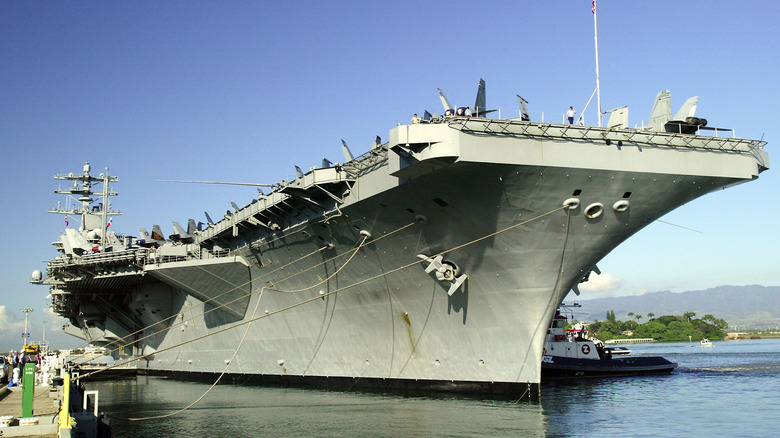
 Aircraft carrier moored shore side

Massive explosive charges were detonated near the hull, including a blast so powerful that the United States Geological Survey recorded it as a 3.9 magnitude earthquake. The purpose of the tests is to confirm that a Navy ship and its systems can survive explosive shock waves in an actual battle and remain fully operational. The tests are also intended to prepare sailors by training them to respond to damage control scenarios in real time. FSST stands as the final proof that America's most advanced warships are ready for war. 

What happens during a shock trial testing

A Full Ship Shock Trial is conducted to test a ship's seaworthiness, but its not done on every warship. It is performed on the first ship of a new class to prove the design for all future vessels of that type. Thousands of sensors and recorders are installed across the ship during the test to measure how its systems respond to underwater detonations. These sensors track stress and vibration levels on equipment, from propulsion machinery to more sensitive electronic systems. In the case of USS Gerald R. Ford, one of the detonations involved a 40,000-pound charge set at a controlled distance from the carrier. 


When the explosion happens, the shock wave travels through the water and slams into the body of the ship, stressing every single component all at once. After each blast, sailors and engineers quickly inspect the vessel, evaluate the data, and then perform any necessary repairs. This process not only verifies the design but also provides the crew with hands-on training in damage control. Together, these steps confirm that the carrier can operate up to design standards and with confidence. 

The U.S. Navy has been testing its carriers by blowing stuff up as a part of its shipbuilding process for decades. For example, the USS Theodore Roosevelt went through FSST in 1987, while other ship classes, such as the USS Wasp and USS Mesa Verde, also had it done. According to a Shock Trial Simulation for Naval Ships document, the Navy pivoted to computer modeling and simulation to avoid the cost, difficulty, and environmental issues that came with the live detonations. However, when the USS Gerald R. Ford introduced new technologies like the Electromagnetic Aircraft Launch System (EMALS) and Advanced Arresting Gear (AAG), it was agreed that a physical explosion test must be used. 

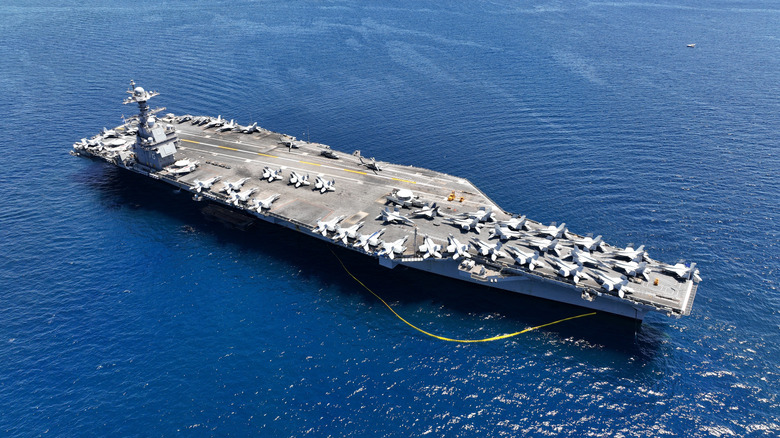
 USS Gerald R. Ford at sea

Congress ordered the carrier to go through FSST to confirm its unproven systems. One of the biggest issues that had to be addressed was the environmental impact, as it took careful consideration and planning to reduce continued damage. Strict exclusion zones and sonar sweeps were used to protect marine life, and testing had to be scheduled to avoid seasonal migrations. All post-test data is critical for the test ship and all future carriers of the class. Despite advancements in simulations, FSST remains the ultimate reality check, proving a ship's battle readiness.

                                           ~~~~~~~~~~~~~~~~~

I have heard of this process, but have never experienced it. It must be quite a shock! [sorry, couldn't resist]

Until next time, stay safe!

                                             Fair winds,

                                                      Old Salt