
1 November 2025: OK! Slow down, damn it! The year is rushing by and we are just standing around letting it! [ed: though I am not sure what we might do to slow it down!]. This post is the one we planned on a couple of weeks ago, but which got bumped by the amazing feat of the two young ladies who successfully rowed across the Pacific Ocean. We are still amazed at that endeavor and the courage and determination it took! The following is from Slashgear.com and covers a subject of (probably) limited interest save for a few of us who might have experienced time at sea with or without aircraft carriers.
~~~~~~~~~~~~~~
Even the most landlocked layman knows an aircraft carrier when they see one. Their long, flat flight deck allows them to carry, launch, and land aircraft, and they are immediately recognizable from any other ship in the Navy. What an enthusiast might not realize that an expert probably would, is that the superstructure jutting up from the deck (known as an island on a carrier) contains the command and control functions of the ship, including the bridge, air-traffic control, radar, and communications antenna, and on older models, the funnel (smoke stack).
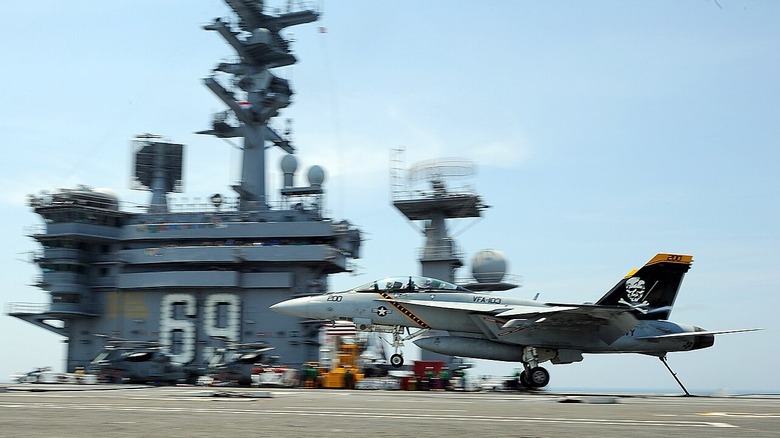
The first aircraft carrier with an island is reported to have been proposed by H.A. Williamson, Flight Officer on the British Royal Navy's seaplane carrier, HMS Ark Royal, in 1915. His idea was initially ignored, and the HMS Argus was built in 1918, sporting a fully flush deck because wind tunnel tests had convincingly shown that including any structure on the deck created incredible turbulence.
However, after the Argus set sail, pilots began reporting they needed a visual reference — preferably located on the starboard side (the right-hand side of the vessel when facing forward towards the bow) – that would allow them to better judge their height off the deck as they came in for a landing. A flimsy wooden and canvas structure was erected, and the problem was solved. Islands on nearly every aircraft carrier (Japanese World War II-era Hiryu and Akagi unsuccessfully experimented with islands on the port side) have since been situated on the starboard (right) side of carriers, thanks to the simple matter of how propellers spin on airplanes.
The engines on most Western aircraft rotate clockwise (when viewed from the cockpit), and in doing so, create what is known as the "P Factor." This aerodynamic phenomenon (also known as "asymmetric propeller loading") happens because, as the propeller blade moves down, it takes a bigger "bite" of air than when it moves up. This, in turn, causes the plane to yaw and naturally move to the left.
There are actually four reasons why a plane naturally veers to the left when it takes off. Isaac Newton's third law of motion states that for every action, there is an equal and opposite reaction. Torque comes into play because the propeller spinning causes the plane's body to twist to port (left), and the pilot must correct for this natural reaction on takeoffs and landings. A third effect is known as "Gyroscopic Precession," and the physics involved primarily impact planes equipped with tailwheels when the tail lifts off the runway while taking off.
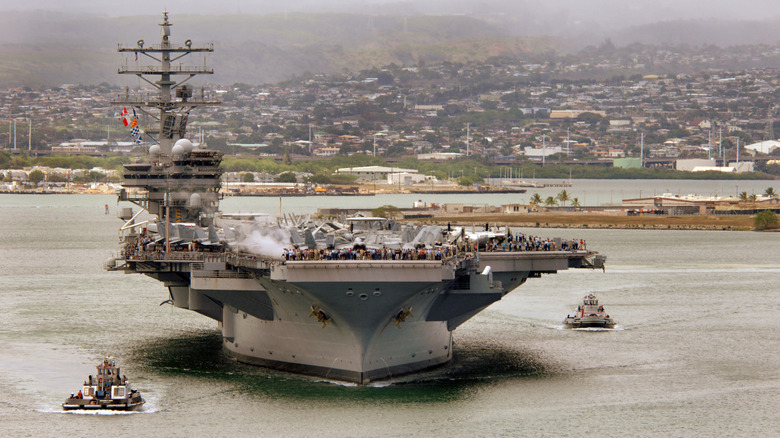
The final effect that causes a left-turning tendency is known as "Spiraling Slipstream." This occurs when the propeller is moving fast but the plane is moving slowly, which is precisely the scenario during takeoff. The slipstreamed air created by the propeller wraps itself around the fuselage of the plane in a corkscrew spiraling pattern and eventually hits the left side of the aircraft's tail, making it yaw to the left. Since all of these naturally occurring physical interactions with propeller-driven airplanes made them veer left, it was clear to Williamson and other early carrier designers to place the island on the starboard (right) side, one of many interesting facts you probably didn't know about aircraft carriers.
~~~~~~~~~~~~~
And so now you know yet another useless bit of information about which you had no - none - zero curiosity! But that is the premise of Maritime Maunder - useless bits of maritime lore and history of limited interest. I feel we are living up to our credo!
Oh! and one more bit of info, hot off the press: it has been announced that the United States (namely the New York Yacht Club) will not be participating in the 2027 America's Cup competition. [ed: not surprising considering their miserable showing in the past two!]. That leaves only New Zealand, the current defender of the cup, and Great Britain as the challenger of record. It will be interesting to see how this plays out.
Until next time, stay safe.
Fair Winds,
Old Salt

No comments:
Post a Comment