Monday, June 13, 2022

US MILITARY SHIPS IN HISTORY - PART ONE

 12 June 2022: Last week we talked about one of the more famous - and certainly significant - ships in the U.S. naval service. This weeks post will take a look at the more significant vessels to fly the U.S. flag from the American Revolution to today. Obviously, that is a huge and lengthy subject so we'll be doing it in several posts; this one and perhaps two more depending on how long they turn out to be. We will try to do it on successive weeks (for purposes of continuity) but sometimes we need a "palette cleanser" to improve the next course. So, stay tuned and we'll see how the story unfolds as well as where the interest of our readers lie. This lengthy research was done by "Stacker" at WUN (an on line service). At the outset, let me offer that the articles all refer to American ships as "USS" (United States Ship), but as we have mentioned before, that prefix didn't occur until the presidency of Theodore Roosevelt in 1905. Prior to then, ships were designated by their design/purpose/rig, i.e. United States Frigate Constitution or U.S Schooner Hannah. So, as you read this and the follow on, keep that fact in mind.

                                        ~~~~~~~~~~~~~~~~

 If a sailor in 1530 magically teleported through the future to the dawn of the American Revolution in 1775, he likely would have been able to get a job aboard a ship in the Continental Navy. Of course, he would have encountered new technologies, new instruments, and new terminology, but the vessel’s riggings, sails, components, cannons, and functionality would have been most familiar. But if a sailor in the Continental Navy teleported the exact same 245 years through the future to 2022 and landed on a U.S. Navy aircraft carrier or a nuclear submarine, he might as well have landed on a spaceship.

The nearly 2 1/2 centuries from when the original colonies first began organizing for maritime battle against their British oppressors to today have witnessed the greatest evolution of naval warfare in human history. The United States and its Navy have fought 12 major wars in those 245 years. That’s an average of a major war every 20 years—not to mention countless actions, security missions, skirmishes, and standoffs.

Each war introduced new naval technology, new tactics, new weaponry, and most importantly, new ships. What started as a single vessel commissioned by frustrated colonists has grown into roughly 300 ships and more than 300,000 personnel in a fighting organization that has dominated the world’s oceans unchallenged for 75 years.

Using government sources like the U.S. Navy’s own archives, as well as historical accounts, news reports, museum databases, and official records of individual ships, Stacker profiled 50 of the most important and consequential warships in American history. Some vessels on this list stand out for their incredible records in battle. Others are noteworthy for the new technologies they introduced. All, however, have earned a place as floating tributes to America’s military preoccupations, technological ingenuity, and ability to project power and enforce its will in the as tensions rose in the run-up to the Revolutionary War, the British launched a campaign to harass, stop, board, search, and seize American merchant ships, nowhere more aggressively than off the shores of Rhode Island. 

Katy
In June 1775, the tiny colony’s legislature authorized the conversion of the Katy—a former whaling, merchant, and privateer ship—to be armed, outfitted, and transformed from a sloop to a sloop-of-war. The ship that would go on to become the U.S.S. Providence was charged with the modest task of single-handedly defending Rhode Island against the British Empire, whose invincible navy had ruled the world’s seas since defeating the Spanish Armada at the end of the 16th century.
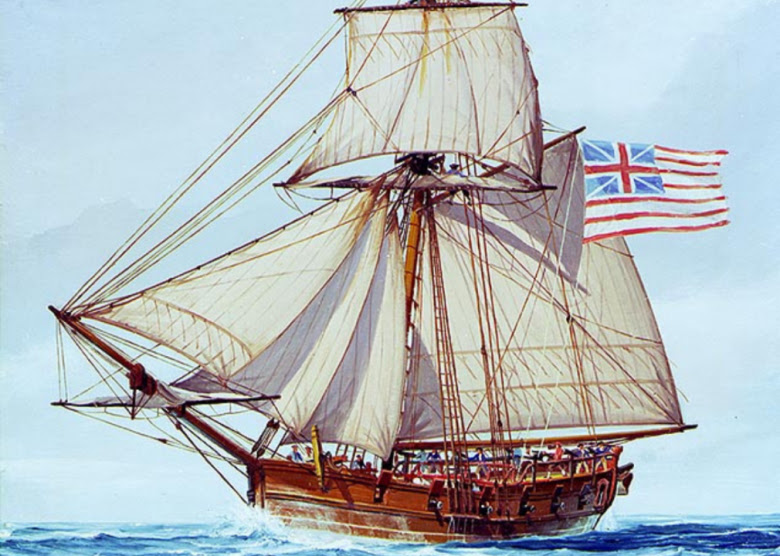
Realizing that the Katy wouldn’t be able to fend off the British empire on its own, George Washington began personally procuring more capable ships. The first among them was the schooner Hannah, which Washington bought on Aug. 24, 1775—it captured its first Royal Navy sloops just a few weeks later in early September. The first armed naval vessel to fight in the Revolution and the first to sail under Continental control, the Hannah is considered the founding vessel of the U.S. Navy.

Hannah

The second of those first two ships was the Cabot. After sailing out of Boston it soon ran into the HMS Milford, a far more capable British vessel. After being forced aground in Nova Scotia, it became the first American ship ever to fall into enemy hands when the British captured it and refitted it for service in the Royal Navy.

 The United States Navy recognizes Oct. 13 1775, as its birthday the day that the Continental Congress authorized the creation of a single, unified navy instead of a patchwork of fleets controlled by individual colonies. It authorized the purchase of two ships to conduct raids on the British, the first of which was the converted merchant brig Andrew Doria, which would soon fight in the Battle of Nassau, the first major maritime combat of the Revolution. The Continental Navy was born.

Andrew Doria
 

The era of the Continental Navy came to an end when the expensive fleet was disbanded after the Revolutionary War. The last of the commissioned Continental warships was the frigate Alliance, which fired the last shots of the American Revolution.

SIX FRIGATES

More than a decade into America’s infancy as a country, it became clear that the pirates known as the Barbary corsairs, who terrorized merchant ships from their North African strongholds, understood only the language of force. No longer under the protection of Great Britain, American vessels were fair game to the relentless pirates, whose campaign of terror, kidnapping, and extortion compelled the U.S. Congress to pass the Naval Act of 1794. The act authorized the construction of what are now known as the ‘Original Six’ frigates of the United States Navy, which would sail under the title United States Ship (USS): USS President, USS Constellation, USS Chesapeake, USS United States, USS Congress, and the most storied ship in American naval history, the USS Constitution.


First launched in 1797, the USS Constitution remains the world’s oldest commissioned ship still afloat and is the official Ship of State of the United States of America. The timbers of the three-masted heavy frigate’s hull were so thick that cannonballs frequently bounced off of them, giving the Constitution its famous nickname “Old Ironsides.” With an other-worldly battle record in the Barbary Wars, the Quasi-War with France and, most notably, the War of 1812, the Constitution represents America’s earliest ability to project force in distant lands—the undefeated ship was never boarded or beaten in battle.

The USS Essex was another prime example of excellence in the early “Old Navy”—as America’s pre-1882 fleet is now called—tallying significant battle success in the Quasi-War with France, the First Barbary War, and the War of 1812. The frigate was the first American ship to sail around the notoriously perilous Cape Horn to the open Pacific Ocean, where it terrorized Great Britain’s whaling fleet. Its success became a burden, however, when the British finally dedicated two of its best ships to hunting down the Essex, which they eventually captured and pressed into the service of the Crown.


 The USS Independence was the U.S. Navy’s first ship of the line, the biggest, most powerful warships of the day. The Independence was part of a large and heavily armed squadron that the Navy sent to North Africa to end the reign of the Barbary Coast Pirates once and for all. When the squadron arrived in Algiers after taking several Algerian ships on the way, the intimidation factor alone was enough to force the enemy to accept a peace agreement, guarantee U.S. trade rights in the region, and return the men and ships they had captured.

Built in the closing days of the War of 1812, the Demologos was a wooden floating battery designed to defend New York Harbor from the British Navy. An otherwise unremarkable vessel, it represents a before-and-after moment in the history of naval warfare as it was the first warship ever to be propelled by a steam-powered engine.

Demologos

The War of 1812 came to a close when the sloop-of-war USS Peacock captured East India Company brig Nautilus in the last naval action of the conflict. The U.S. Navy wouldn’t capture another enemy ship until World War II. The Peacock also holds the distinction of being the first ship the United States ever outfitted for scientific exploration when it was sent to explore and survey the farthest reaches of the mighty Pacific Ocean.

                             ~~~~~~~~~~~~~~~~~~

I have to offer that some of these ships were new to me and while obviously significant, are pretty obscure. We all learn something new. So, that gets us through the War of 1812; next up will be Spanish American War and beyond. So, watch for that in the coming weeks. Until then,

                                                 Fair Winds,        

                                                   Old Salt                                             


Monday, June 6, 2022

MONITOR WRECK - RE-DUX

 6 June 2022: A few years back, we posted some pictures and the story of the U.S. Ironclad Monitor, the famed start of the "modern" navy - as far a ship construction is concerned. She fought the Confederate ironclad, CSS Virginia (nee Merrimack) in Hampton Roads VA during the American Civil War. Neither won but the concept of iron cladding a ship was proved beyond a doubt. Monitor, during a tow offshore in December of 1862, was overwhelmed with storm seas and was cut lose from her towing vessel as she began to sink. Here is some further info on the wreck following the recovery of her turret (which is on display in the Newport News (VA) maritime museum. It's from the Center Daily Times.

                                         ~~~~~~~~~~~~

One of the nation’s most revered military shipwrecks was visited in May by a NOAA-backed team and they made a surprising discovery 16 miles off North Carolina. The Civil War ironclad USS Monitor is apparently refusing to surrender to the forces of nature. Despite being on the seafloor since 1862, the first-of-its-kind ship remains in “an excellent state of preservation,” according to Tane Renata Casserley, resource protection and permit coordinator at the National Oceanic and Atmospheric Administration’s Monitor National Marine Sanctuary. That’s all the more surprising given Navy divers made significant intrusions into the shipwreck in 2002, when they recovered the highly prized turret and other artifacts for preservation, he said. “The wreck is in an astounding condition after being on the seafloor for 160 years and weathering all of the environmental conditions off Cape Hatteras, including exceedingly strong currents and hurricanes,” Casserley told McClatchy News.

Monitor's gun barrel, preserved in Newport News Maritime Museum


“During those (2002) projects, it was necessary to cut into the ironclad’s armorbelt, hull, and deck to gain access to the turret since the shipwreck was on top of it. The question for us at NOAA was, did those cuts into the shipwreck cause further deterioration? Would we see significant changes caused by these actions today?” The answer to those questions “was a resounding ‘No’,” he said. It’s a revelation that begs explanation, and Casserley has a theory.

The USS Monitor was visited as part of the Valor in the Atlantic expedition, which sent a remotely operated camera to explore multiple ships sunk during the Civil War and World War II. The USS Monitor was the oldest and most important of them, as the first U.S. warship built with a revolutionary rotating gun turret, NOAA reports. Monitor sank on New Year’s Eve in 1862, in a region off North Carolina known as the Graveyard of the Atlantic, due to an estimated 2,000 shipwrecks. Sixteen U.S. sailors were lost in the sinking, historians say. “The waves grew and the wind howled. With each pitch and roll, shock waves ravaged the crew and the hull of the little ship,” according to a NOAA report. “Leaks developed, flooding the engines and reducing steam pressure needed for propulsion. The crew tried using pumps and even bailing with buckets, but the distress was too great. ... The turret was the only escape hatch from below and as the men attempted dashing across the deck many of them were swept into the unknown by the treacherous waves.” The Monitor was rediscovered in 1973 — “lying upside down in 230 feet of water” — by the Duke University Research Vessel Eastward and efforts to protect the first-of-its-kind vessel began almost immediately, NOAA reports. In 1975, the USS Monitor site became “the nation’s first national marine sanctuary,” a move that intends to protect and preserve it as an important part of the “nation’s maritime heritage.”

The Valor in the Atlantic expedition May 15-25 counted as “the first examination of the site” since 2002, and Casserley feared it would show the turret recovery project led to advanced deterioration. Finding otherwise has left the scientists looking for explanations, and Casserley thinks the “robustness of Monitor’s construction” continues to defend it. “That same iron armor that deflected cannonballs fired at point blank range and even collisions ... has now contributed to its longevity on the seafloor,” Casserley says. “That same iron hull and armorbelt built to withstand the rigors of war, has now enabled Monitor to provide a stable habitat in its new role as an island of life. It truly was incredible to see the transformation at the bottom of the ocean. There was often so much marine life on Monitor it was difficult to see the shipwreck itself.” A remotely operated camera examined only the exterior, so questions remain about the what’s happening inside of the vessel, he said. The expedition team, which partnered with the Global Foundation for Ocean Exploration, left the wreck realizing much of it remains unaltered, offering an extraordinary opportunity for marine archaeologists and historians. “This area is a time capsule back to 1862 to learn more about how the crew lived and worked aboard a prototype ironclad warship,” Casserley said. “In some regards is in better structural shape than the majority of shipwrecks from the same time period as well as extending to the WWII-era shipwrecks. The bottom line is USS Monitor will be here for generations to come to share its stories of heroism.”

                                           ~~~~~~~~~~~~~~~~~

I have visited the museum and seen the artifacts - amazing to behold - and the reproductions of the  two combatants. A site we can unequivocally recommend should you find yourself in or around Newport News. And as a "P.S.": the prefix USS (United States Ship) was not in common use until January, 1907 (Pres Theodore Roosevelt) and clearly, not during the Civil War as, obviously, the country was NOT the United States!

Until next time,

                                              Fair Winds,

                                                        Old Salt


Saturday, May 28, 2022

MEMORIAL DAY 2022

 28 May 2022: Monday, 30 May, is celebrated here in the United States as Memorial Day, originally known as "Decoration Day." Most countries have a similar holiday - some call it "Remembrance Day," - but the concept is still the same: recalling to mind and memory those who perished in service to their countries, generally fighting for the ideals espoused by their own nations. Following is the History Channel's description of the genesis of Memorial Day here in the United States. And while it's not specifically maritime in nature, those who died in service came from all the armed forces.

                                              ~~~~~~~~~~~~


Memorial Day is an American holiday, observed on the last Monday of May, honoring the men and women who died while serving in the U.S. military. Memorial Day 2022 will occur on Monday, May 30. 

Originally known as Decoration Day, it originated in the years following the Civil War and became an official federal holiday in 1971. Many Americans observe Memorial Day by visiting cemeteries or memorials, holding family gatherings and participating in parades. Unofficially, it marks the beginning of the summer season.

The Civil War, which ended in the spring of 1865, claimed more lives than any conflict in U.S. history and required the establishment of the country’s first national cemeteries.


By the late 1860s, Americans in various towns and cities had begun holding springtime tributes to these countless fallen soldiers, decorating their graves with flowers and reciting prayers.

It is unclear where exactly this tradition originated; numerous different communities may have independently initiated the memorial gatherings. And some records show that one of the earliest Memorial Day commemorations was organized by a group of formerly enslaved people in Charleston, South Carolina less than a month after the Confederacy surrendered in 1865. Nevertheless, in 1966 the federal government declared Waterloo, New York, the official birthplace of Memorial Day.

On May 5, 1868, General John A. Logan, leader of an organization for Northern Civil War veterans, called for a nationwide day of remembrance later that month. “The 30th of May, 1868, is designated for the purpose of strewing with flowers, or otherwise decorating the graves of comrades who died in defense of their country during the late rebellion, and whose bodies now lie in almost every city, village and hamlet churchyard in the land,” he proclaimed.

The date of Decoration Day, as he called it, was chosen because it wasn’t the anniversary of any particular battle.

On the first Decoration Day, General James Garfield made a speech at Arlington National Cemetery, and 5,000 participants decorated the graves of the 20,000 Civil War soldiers buried there. Many Northern states held similar commemorative events and reprised the tradition in subsequent years; by 1890 each one had made Decoration Day an official state holiday. Southern states, on the other hand, continued to honor the dead on separate days until after World War I.

History of Memorial Day

Memorial Day, as Decoration Day gradually came to be known, originally honored only those lost while fighting in the Civil War. But during World War I the United States found itself embroiled in another major conflict, and the holiday evolved to commemorate American military personnel who died in all wars, including World War II, The Vietnam War, The Korean War and the wars in Iraq and Afghanistan.

For decades, Memorial Day continued to be observed on May 30, the date General Logan had selected for the first Decoration Day. But in 1968, Congress passed the Uniform Monday Holiday Act, which established Memorial Day as the last Monday in May in order to create a three-day weekend for federal employees. The change went into effect in 1971. The same law also declared Memorial Day a federal holiday.

                                                                                       ~~~~~~~~~~~~ 

So, for those of you here in the US of A, take a moment to reflect on those we have lost; it is because of their sacrifice that we can enjoy the freedoms we have today. That is the true meaning of Memorial Day; it isn't just hot dogs, barbecues, and baseball.

Until next time,

                                    Fair winds,

                                              Old Salt