2 April 2021: Well, they freed the Ever Given - actually in under a week - but she's still "stuck" in the Canal while an investigation proceeds.... gotta love bureaucracy! On the positive side, however, ships are passaging through the Canal and it looks as though the shipping owners who directed their vessels to head south around Cape of Good Hope were wrong and the ones that waited will be at the destination ports before the ones taking the long route. Oh well, we gotta play the hand we're dealt and can only use the information available at the time.
Today's story is about a ship of the same class, Fletcher Class (DD445) which your humble scribe spent almost six years aboard in the mid-sixties (I was on 2 different, one slightly older and one slightly younger than Johnston) and so, somewhat near and dear to my heart. This comes from Rebecca Movelle of BBC News:
~~~~~~~~~~~~~~~~~~
A submersible has dived to the world’s deepest-known shipwreck.
The vessel reached the USS Johnston, which lies 6.5km (4 miles) beneath the
waves in the Philippine Sea in the Pacific Ocean.
 |
Mounts 51 and 52 (forward on main and 01 decks)
|
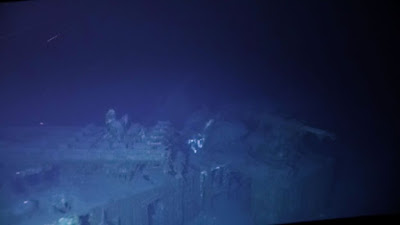 |
midships torpedo racks 01 deck
|
Explorers spent several hours surveying and filming the wreck over a series
of dives.
The 115m-long US Navy destroyer sank during the Battle off Samar in 1944
after a fierce battle with a large fleet of Japanese warships.
Victor Vescovo, who led the expedition and piloted the sub, said: “The wreck
is so deep so there's very little oxygen down there, and while there is a
little bit of contamination from marine life, it's remarkably well intact
except for the damage it took from the furious fight.”
The remains of the USS Johnston were first discovered in 2019, and parts of
the destroyer were filmed with a remotely operated vehicle (ROV).
But a large part of the wreckage lay deeper than the ROV was able to reach,
so for this expedition a submersible called the DSV Limiting Factor was
deployed.
The vessel has a 9cm-thick (3.5in)
titanium pressure hull that two people can fit inside, and it is able to
descend to any depth. Previously it has explored the deepest place in the
ocean, the Mariana Trench, which lies almost 11km down, as well as the Titanic.
It took several dives to relocate
the wreck of the USS Johnston, but then Victor Vescovo, along with engineer
Shane Eigler on one dive and naval historian Parks Stephenson on another, were
able to spend time surveying and filming the destroyer.
Mr Vescovo said that the hull number – 557 – was clearly visible on both
sides of its bow, and two full gun turrets were also intact.
 |
USS Johnston (DD557) in better times
|
“The gun turrets are right where they're supposed to be, they're even
pointing in the correct direction that we believe that they should have been,
as they were continuing to fire until the ship went down,” he explained.
“And we saw the twin torpedo racks in the middle of the ship that were
completely empty because they shot all the torpedoes at the Japanese.”
The team is now working with naval historians in the hope of shedding more
light on the World War Two battle.
The relatively small USS Johnston was heavily outnumbered by the Japanese
fleet, which included Japan’s largest battleship, but was awarded for its
courage under heavy fire.
Of the crew of 327, only 141 survived the battle.
No human remains or clothing were found during the expedition, and the team
laid wreaths before and after the dives.
~~~~~~~~~~~~~~~~~
I am sure some of you thought, "Wait - isn't the Titanic wreck the deepest?" Well, friends, no, it is not. The Johnston wreck is almost 2 miles deeper! There are many more wrecks from WWII in the western Pacific and researchers continue to seek them - to answer questions, not for riches or spoils. The ships o the 445 Class of Destroyer were fast (36 kts) and carried a variety of guns, generally 5 5"/38 (cal), 3 3'/50, and a battery of 20 and 40 mm anti aircraft guns as well as torpedo tubes, depth charges, and some K guns (thrown depth charges). They were indeed a formidable foe and their crews of 300 men and officers loved them.
Until next time,
Fair winds,
Old Salt


