Saturday, November 5, 2016

USS ZUMWALT DDG 1000

5 November 2016: We have written about the Navy's newest destroyer on this site in the past. Now that she is completed, commissioned, and an official unit of the fleet en route to her new home port of San Diego, we thought an update might be worth adding to these pages. The ship is truly a marvel, and this article from the Department of Defense adds some "wow factor" to the story. One interesting point it does not make is that during her sea trials off Maine this past winter and early spring, her radar return was so slight that they had to hang a radar reflector on her mast so the local fishing boats would see her in the prevalent foggy conditions!


From Katie Lang's article (DoD): Eight Interesting Facts about USS Zumwalt:

#8: Her commanding officer of Cap't James Kirk! Really! 


Anyone who knows anything about “Star Trek” just giggled right now.
Yes, the Zumwalt’s captain has the same name as that of the sci-fi show’s illustrious starship, the USS Enterprise. Except the Zumwalt’s captain is James A. Kirk, not James T. Kirk, and he was named after his grandfather – not William Shatner’s character.
“Unfortunately, I came out after the TV show started, so people can accuse my parents of being Trekkies,” Kirk joked. “But they tell me no – it was all about my grandfather."

#7: The ship produces enough power to run a small city.

“I have in excess of 78 megawatts of power that I get to choose what I do with,” said Lt. Cmdr. Nate Chase, the Zumwalt’s chief engineer. He said that’s really what is going to provide opportunity for future weapons and sensor development.
“On an Arleigh Burke [class destroyer], you have nine megawatts of electrical power, and you have dedicated gas-turbine engines for propulsion, but that’s all they’re good for. You can’t harness any of that potential,” Chase said. “On here, with the two main turbine generators and your two auxiliary turbine generators, the commanding officer can decide what his priority is for that power – is it propulsion or a gun system or radar or the sonar system? So, you can reallocate the assets of the power where you need it depending on the mission you’re being dealt.” 


#6) Its physical shape is part of what makes it stealth.
The fact that the Zumwalt has a lot fewer things top-side helps make it harder to detect than most ships.
The Zumwalt has 1/50th of the radar cross-section of an Arleigh-Burke-class destroyer, meaning the blip it produces on a radar screen is 50 times smaller. Considering the Zumwalt is 1.5 times bigger than an Arleigh-Burke, that’s pretty substantial.


5) It has a much smaller crew than other ships.
While most Navy destroyers have about 300-350 sailors aboard, this one has 147. Chase said the change has been a bit of an adjustment.
“From the most senior leadership to the most junior sailor, working with a smaller crew, working in closer quarters, it’s become a pretty close family,” he said. “It’s hard not to when you’re experiencing everything together.”

4) Fewer crew members equals a lot more automation.
 The computer architecture on the ship is very complex and sophisticated, so the crew is interacting with a lot of new technology.
“For example, we have over 35,000 signals that are being taken, processed and displayed on the ship. That’s about five to 10 times other classes of ships,” Kirk said. “There’s a lot less interface with manual valves.”
3) Every sailor on the ship is in a state room.
When you cut the number of crew members in half, what do you get? More space.
“Unlike a ship that has a 40-, 60- or 80-sailor bunk room, every sailor on this ship is in a state room,” Kirk said. “When they wake up, they wake up to only one or two alarm clocks, not four or 50. And then they have their own facilities in that state room to take care and prepare for the day.”
2) It’s a pretty smooth ride.
The Zumwalt has a tumblehome hull, meaning its sides slope inward above the waterline, so it cuts easily through big waves, making for a much smoother ride than other ships. Chase said there’s no listing back and forth, especially in heavy seas.
“This blows the [Arleigh] Burke out of the water,” he said.
“It rides marvelously,” Kirk said of the 15,500-ton destroyer. “I would say it feels like a really souped-up sport utility vehicle. … It’s like a very big SUV that’s made to go very fast.
1) The destroyer is named for Adm. Elmo Zumwalt Jr.
Admiral Elmo Zumwalt Jr. was a wartime legend, having served in World War II and Korea before becoming the commander of all naval forces during the Vietnam War.
“He was a great man who reformed the Navy to make it a more just institution,” Kirk said.
His 37-year career was very impressive.

That'll do it for now; until next time,

                               Fair Winds,
                                   Old Salt


Sunday, October 30, 2016

HALLOWEEN EVE ...

30 October 2016: Ok - so it's not really maritime, but it is timely.... (sorry, couldn't resist that one) and I thought my readers might enjoy an interesting kind of spooky piece I recently came across about the Viet Nam War. Having spent a few years in that theatre myself, I do not doubt the veracity of what this article relates; there was lots of weird and unorthodox stuff going on over there. So, lightly edited, from Military History Now, here it is.


JUST AFTER dusk on the night of Feb. 10, 1970, the jungles near the U.S. Army’s Fire Support Base Chamberlain in Hau Niga Province, South Vietnam came to life with a cacophony of spine chilling sounds. Mournful wailing, sobbing, and baleful shrieks filled the air — unearthly sounds that seemed to be coming from everywhere, but nowhere in particular.
And amid the blood curdling chorus was a clearly audible warning:
“My friends,” pleaded a disembodied voice from across the darkness, “I have come back to let you know that I am dead… I am dead!”
“It’s hell… I’m in hell!” it continued in Vietnamese. “Don’t end up like me. Go home, friends, before it’s too late!”
The eerie warning was followed by a chorus of other strange sounds: banging gongs, sobbing women and a child’s voice calling for her father.
To the Viet Cong soldiers hiding in blackness beyond the American perimeter, these otherworldly sounds sounded like the wandering souls of departed comrades. According to local folklore, the sprits of the dead that were not returned home for proper burial were cursed to walk the earth in torment until their remains were found and properly interred. Vietnamese legends held that on the anniversary of the death of one of these lost souls, a spiritual channel between our world and the afterlife opens making communication possible.
Were these hair-raising sounds just such a phenomenon? Were they spirits of the dead of some past battle reaching out to the living? Perhaps to the communist guerrillas listening it seemed that way.
The reality was something much less fantastic.
Operation Wandering Soul
The noises were actually part of a taped broadcast that was being blasted across the countryside by American GIs armed with portable PA speakers. In fact, the entire program had been recorded weeks earlier in a Saigon sound studio. It was all part of a top secret U.S. military psychological warfare campaign known as Operation Wandering Soul. The voices and noise played in the jungle that night came from a session known unofficially as “Ghost Tape No. 10”.
Organized by the U.S. Army’s 6th PSYOP battalion in cooperation with the U.S. Navy, the Wandering Soul campaign was intended to frighten and demoralize the enemy, and hopefully compel many to desert their positions.
Following the broadcast that night, elements of the 27th Infantry Regiment (nicknamed the “Wolfhounds”) swept the jungles surrounding Fire Support Base Chamberlain in search of trembling VC insurgents. The mission netted three prisoners – a moderate success.
And this was not the only broadcast of the PSYOP horror show.
Various American units employed similar recordings in a number of areas in South Vietnam in late 1969 and early 1970 with mixed results.
On one occasion, the broadcast included an amplified tiger’s growl (which was recorded at the Bangkok zoo). The remix was transmitted over a communist-controlled hilltop in South Vietnam. It supposedly led to 150 VC to abandon their positions.
In other cases, the recordings were played from speakers mounted on helicopters and were supported by leaflet drops. In some cases, enemy soldiers realized it was a hoax and concentrated their fire onto the choppers.
Yet in a number of instances, the tapes were so effective that they reportedly terrified friendly South Vietnamese troops and civilians alike.
One former PSYOP officer recalled that even if the enemy saw through the ruse, the message at least played upon their anxieties about dying far from home and likely sapped their morale. 

Hope that inspired your Halloween spirit! 

Until next time, 
                                             Fair Winds, 
                                                  Old Salt

Saturday, October 22, 2016

USS CONSITITUTION CELEBRATES ANOTHER YEAR

HAPPY BIRTHDAY, USS CONSTITUTION
22 October 2016: (this is a lightly edited update of a post from last year - but nonetheless, appropriate for today.) Yesterday we celebrated the 219th birthday of America's Ship of State!  USS Constitution was launched 21 October in 1797. Happy birthday, old girl . . . or should I say, "Old Ironsides." Yes, the Hartt Shipyard in east Boston slid our Ship of State into the waters of Boston Harbor 219 years ago!

Her launch is depicted in this glorious image by renowned marine artist, Paul Garnett. It currently resides in the permanent collections of USS Constitution Museum, Boston.


She was built as a result of the Naval Act of 1794 signed by George Washington in recognition of the fact that our newly independent country needed a navy to deal with foreign enemies, most notably (at that time) the Barbary Pirates of North Africa. Six frigates were authorized and built in varying locations including Boston (Constitution), Philadelphia (United States), Baltimore (Constellation), and others. Three of the six were designated as "heavy" frigates, meaning that they would carry at least 44 guns which would fire a 24 pound iron ball; and three as lighter frigates of 36 to 38 guns. As a matter of practicality, none ever carried their rated allotment; it was always more, sometimes by as many as ten!

Constitution fought at Tripoli, the third flagship sent over to deal with the pirates - Edward Preble was the commodore in charge of that fleet and acted most aggressively against the Barbary corsairs. But it was in the War of 1812 that Constitution really earned her stripes . . . and her nickname, Old Ironsides.

USS Constitution finishing off HMS Guerierre
 After a very bad two months of war against England, the ship, under Isaac Hull, encountered and defeated HMS Guerierre in single ship combat. This was the battle in which she won her famous nickname. It was a glorious and most welcome victory for the Navy and more generally, the United States following lots of bad news from the Western frontier. Shortly thereafter, under William Bainbridge, Constitution headed south and found HMS Java off South America. A sharp battle ensued and Old Ironsides once again was victorious.

Constitution (foreground) vs Java
Perhaps one of her most famous fights occurred in February of 1815, technically after the war was over, against two Royal Navy frigates, HMS Cyanne and HMS Levant. She took them both but Levant was recaptured by the British before she got back to a U.S. port as a prize.
After serving as a training ship, barracks, and very nearly being scrapped, she assumed her role as good will ambassador, a role she has performed brilliantly for many years from her berth in historic Charlestown Navy Yard. She was named "Ship of State" a couple of years ago and continues to shine! She sailed under her own sails for the first time in over 100 years in October of 1997, in celebration of her 200th birthday. I was there! Here's a couple of pictures of that amazing event!
in the image to the left, you might notice the Blue Angels over top!
It was an awe inspiring event and then, in recognition of the 200th anniversary of her victory over HMS Guerierre, she sailed again in 2012, albeit in a very light breeze and remained in Boston Harbor. USS Constitution Museum, in the Navy Yard, acts as the "voice" of Constitution and is privately funded, not being an agency of the federal government. the museum is marvelous, and not to be missed if you find yourself in Boston!

USS Constitution is the OLDEST SHIP AFLOAT IN THE WORLD. What about HMS Victory, I heard someone mumble? Well, Victory is indeed older, but she is also resting comfortably in concrete in Portsmouth Royal Dockyard in England where she just finished a refit and new paint job. Constitution is usually afloat and indeed, gets underway, albeit with a tug alongside. And even though she now is undergoing her own refit in historic Dry Dock #1 at the Charlestown Navy Yard, she will be refloated in a couple of years and once again, be doing her famous "harbor cruises" in Boston. Incidentally, should you be interested in a live image of Constitution in dry dock. Here's a link:
 
                   Live camera of USS Constitution

Incidentally, Constitution is carried on the rolls of commissioned U.S. Navy and is manned by active duty Navy sailors and officers! 

"I feel a strong predelection [sic] for the Constitution. I think  . . . she will be a most fortunate ship; and I am sometimes good in my predictions . . ." Tobias Lear, consul general to the Barbary Regencies in a letter to Capt. John Rodgers, 16 October 1804.

                                       Fair Winds,
                                                Old Salt
 
PS Maritime Maunder has now passed 21,200 readers worldwide


Friday, October 14, 2016

ROALD AMUNDSEN'S SHIP RAISED

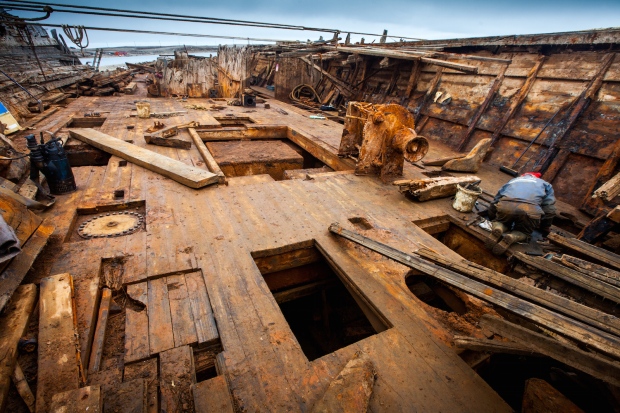
14 October 2014  Discovered some six years ago in Canada's Nunavut waters near Cambridge Bay, a team of Norwegian archeologists have raised from her icy grave and begun to stabilize the wreck of what had been Roald Amundsen's Arctic exploration vessel, Maud.


"It's a beautiful ship and she's very strong," says Jan Wanggaard, the project manager for the recovery team.

"We're very happy now that we can see the Maud is in an extremely good state."


The Maud’s egg-like shape helped preserve its structure under heavy ice pressure, says Wanggaard. (Submitted by Jan Wanggaard)

The Maud was launched on June 7, 1917, and captained by Amundsen during his 1918-20 expedition into the Northeast Passage above Russia. It was sold in 1925, and sank in 1930 after getting trapped in the ice near Cambridge Bay. 


And despite being submerged in Arctic waters for more than 80 years, the ship has maintained much of its integrity.

Wanggaard and his team have been coming to the area to work on the wreck every summer for six years.


In June, the team began inflating air bags and balloons around the ship. Their experience with an unsuccessful lift last year helped them come better prepared with additional flotation devices. 

Finally in July, the Maud floated for the first time since it sank.


After a month of cleaning the Maud starts to reveal its beautiful details. (Submitted by Jan Wanggaard)

Throughout July and August, the team worked on placing the ship on top of a barge. And for most of September their work consisted of cleaning out the inside of the ship.

"She was quite covered with mud and other debris," says Wanggaard.

The Maud now rests on a barge near the coast. Over the winter it will freeze in place.

"That is actually good for the Maud, because she needs to dry," says Wanggaard.

"It's worth taking her back to protect her for the future, because sooner or later she would have been completely destroyed by nature."

The Maud's excellent shape gives Wanggaard and his team renewed hope that it can begin the journey back to Norway next summer when the team returns to Cambridge Bay.

Their task next year will be to stabilize the ship on the barge and make it seaworthy.
 
Thanks to Crystal Safadi and CBC for contributing to this post.
 
Until next time,
                                Fair Winds,
                                            Old Salt


Friday, October 7, 2016

HMS TERROR FOUND - PARKS CANADA

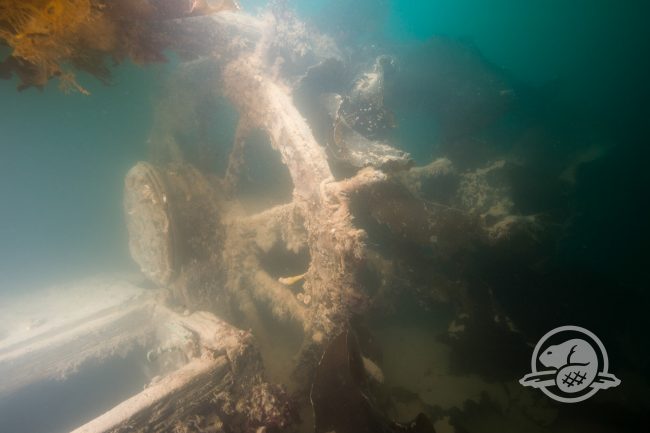
7 October 2016: A while back we posted a story about Parks Canada discovering the whereabouts of one of the two Franklin Expedition ships lost in the ice of Canada during their quest for the fabled Northwest Passage. (mid 19th Century). The two ships, HMS Erebus and HMS Terror vanished with nary a trace and all hands were lost, some while trying to trek across the ice to some form of civilization. None made it.
Parks Canada discovered Erebus last year and have dove the wreck confirming it's provenance. At that time, Terror remained lost. Now she's been found and her identity confirmed. An interesting fact, possibly, is that HMS Terror was originally a bomb ship used by the British in the War of 1812 against Fort McHenry in mid September 1814 and which inspired Francis Scott Key to pen what would become our National Anthem. She was converted for use in the Arctic and made 2 expeditions there.

HMS Terror on her 1st Arctic voyage


 The announcement from Parks Canada:

The Canadian Government has confirmed that it has in fact found the wreck of the HMS Terror, the second ship of the ill-fated 1845 Franklin Expedition to find the Northwest Passage.


Parks Canada confirmed Monday the wreck located in Nunavut’s Terror Bay just off King William Island is that of HMS Terror. The confirmation was made by Parks Canada’s Underwater Archeology Team based on a side-scan sonar survey and three dives to the wreck, which included additional surveys of the wreck using multi-beam echosounder.

Earlier this month, Britain’s Guardian newspaper reported that a team from the Arctic Research Foundation, a private and non-profit group participating in the hunt for the famous shipwreck, had discovered the HMS Terror in pristine condition at the bottom of a bay. The Canadian Government was yet to confirm the report however.

Franklin’s first ship, the HMS Erebus, was discovered in 2014 approximately 100 km south of Terror Bay.

Sir John Franklin along with his 128 crew aboard the HMS Terror and HMS Erebus all died after the vessels became stuck in ice during a search for the Arctic passage between the Atlantic and Pacific oceans.

The findings help shed light on one Canada’s greatest mysteries.
 
Truly an amazing discovery!
Until next time,
                                   Fair Winds,
                                            Old Salt